


HV Switchgear vs High Voltage Circuit Breaker: Key Differences and Selection
HV Switchgear and a High Voltage Circuit Breaker are compared so often that the comparison itself has become misleading. One is an assembly; the other is a component that usually sits inside it. The distinction matters commercially, because a buyer who orders a breaker expecting a lineup receives something that will not terminate a cable, earth a circuit or contain an arc. This guide sets out what each does, where each is the right purchase, and the ratings to check before either is ordered.
HV Switchgear VS High Voltage Circuit Breaker: Key Differences
The comparison only works if both terms are defined the way the standards define them, because everyday usage is loose. A breaker is a device with a rated breaking capacity. HV Switchgear is an assembly with a rated short-time withstand current and, where it is claimed, a rated internal arc classification. Those are different qualifications, tested differently, and neither one implies the other.
| Aspect | HV Switchgear | High Voltage Circuit Breaker |
|---|---|---|
| What it is | An assembly of switching devices with busbars, control, measurement and protection, in an enclosure | A single device that makes, carries and breaks current, including short-circuit current |
| Scope | Several circuits on a shared busbar | One circuit |
| Defining rating | Short-time withstand current and duration, internal arc class | Short-circuit breaking current, peak making current |
| Delivered as | A lineup of cubicles, a ring main unit, or a kiosk | A unit on a frame, a pole bracket, or a truck for a cubicle |
| Governing standard | IEC 62271-200 for metal-enclosed assemblies from 1 kV to 52 kV | IEC 62271-100, with IEC 62271-1 covering both |
Equipment Functions And System Roles
A breaker has three duties and the third one defines it: it makes current, it carries current, and it breaks current. Making and carrying are shared with switches and contactors. Breaking a short circuit — extinguishing an arc that is still being fed by the network — is what separates a breaker from everything else in the lineup. That is why the rated short-circuit breaking current is the number buyers argue about, and why it is only meaningful when read with the operating sequence beside it.
HV Switchgear has a different job. It gives the breaker somewhere safe to live and something to connect to: a busbar that distributes to the other circuits, a cable compartment where terminations are made off, an earthing switch that makes the circuit safe to work on, interlocks that prevent the wrong sequence, shutters that cover the live spouts when the breaker is withdrawn, and an enclosure that directs an arc away from anyone standing in front of it. None of those functions belong to the breaker.
This is why the phrase High Voltage Switchgear Breakers is more accurate than it sounds: it describes the breaker as a member of an assembly rather than as a rival to it. The one place the distinction genuinely collapses is the outdoor product. A pole-mounted or pillar-type breaker is sold as a standalone unit, sits on its own frame, and has no busbar, no cable compartment and no lineup around it. In that case the breaker is the installation, and the question becomes how much enclosure and earthing the site still needs.
So the practical question is rarely “switchgear or breaker”. It is “how many circuits share a busbar, and how much enclosure does the site require”. Everything else follows from those two answers. For the vocabulary, what switchgear actually covers is a useful starting point before the ratings discussion.
Construction And Main Components
A medium-voltage breaker contains an interrupter per pole — a vacuum bottle, or an SF6 chamber at higher voltages — an operating mechanism that stores energy and releases it, a pole assembly with bushings or cast-resin insulation, terminal pads, a mechanical position indicator, auxiliary contacts, and local manual controls. Everything in that list exists to serve one function: open and close reliably, at speed, with the arc contained.
An HV Switchgear lineup contains all of that plus the systems that make it usable as a network node. The table below is the shortest way to see where the boundary falls.
| Component | In The Breaker | In The Lineup |
|---|---|---|
| Interrupter | Yes — vacuum bottle or SF6 chamber | Carried by the breaker inside it |
| Operating mechanism | Yes — spring, permanent magnet or magnetic actuator | Accessed through the low-voltage compartment |
| Busbars | No | Yes — main busbar compartment, rated for withstand |
| Earthing switch | No | Yes — interlocked with the breaker position |
| Cable compartment | No | Yes — cable terminations, CTs, surge arresters |
| Shutters and interlocks | Mechanism interlocks only | Yes — truck, earthing switch, door and partition chain |
| Protection relay and metering | Integrated controller on an intelligent unit | Yes — separate relay panel and CT circuit |
| Arc containment | Not applicable | Yes — venting ducts and a tested arc classification |
The construction choice inside the lineup changes how the breaker is mounted, and that changes the maintenance cost for the next twenty years. In a metal-clad design such as the KYN28-12, the breaker is a withdrawable truck that racks out of its compartment; in a metal-enclosed design such as the HXGN, the breaker is fixed and the whole panel is isolated to work on it. The difference between those two philosophies is set out in metal-clad versus metal-enclosed switchgear, and it matters more to lifecycle cost than the purchase price does.
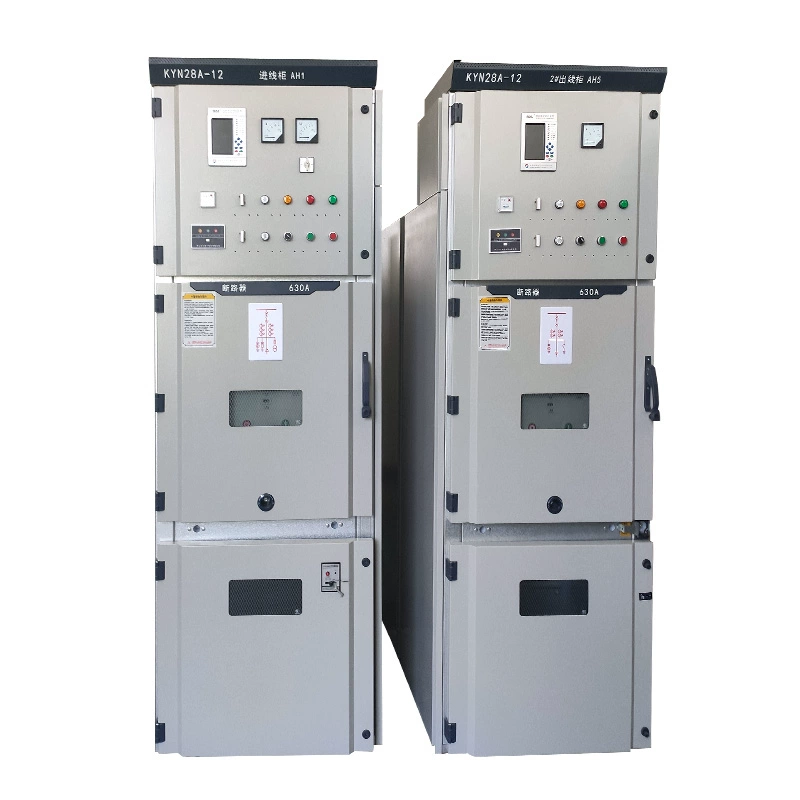
A lineup is what the breaker becomes part of: busbar compartment, withdrawable breaker, cable compartment and low-voltage panel behind each door.
Fault Interruption And Protection
The breaker interrupts the fault. The assembly withstands it. Inside any HV Switchgear lineup those are two different tests and two different ratings, and conflating them is the most expensive mistake in this subject.
The breaker carries a rated short-circuit breaking current in kiloamps, a rated peak withstand current that it must also be able to make onto, and an operating sequence such as O-0.3 s-CO-3 min-CO that says how many fault operations it can chain together before it needs a rest. A High Voltage Circuit Breaker of 31.5 kA is stating what it can interrupt, not what it can survive being installed inside.
The assembly carries a rated short-time withstand current with a duration, commonly 20, 25 or 31.5 kA for 1 s or 3 s, plus a rated peak withstand current. It may also carry an internal arc classification: a tested current and duration, an accessibility type A or B, and a classification letter that records which sides of the enclosure the test was applied to and whether the arc was contained. If the assembly is rated 25 kA and the breaker inside it is rated 31.5 kA, the installation is a 25 kA installation. The weaker rating governs, and it is always the assembly.
Protection follows the same split. The relay decides, the breaker acts. In an intelligent standalone unit the controller is built into the breaker and reads its own CTs. In a lineup the relay is a separate device in the low-voltage compartment, fed by CTs in the cable or busbar compartment, and the trip path runs through the auxiliary contact block. The internal arrangement of that path is worth understanding before specifying it, and the components inside a switchgear lineup maps them compartment by compartment.
Internal arc is the rating that decides whether a breaker can substitute for a lineup, and it is the one buyers ask about last. A standalone breaker on a pole has no arc classification because there is no enclosure to test and nobody standing in front of a door. A lineup has one because a person opens a door, and the enclosure is the only thing between that person and a fault. No breaker, however good, provides that.
Installation And Application Conditions
A standalone outdoor breaker is installed on a pole bracket or a steel frame, with the cable terminating directly on its bushings and a small control cabinet bolted to the frame. It needs no switchroom, no cable basement and no ventilation duct. It is built for the weather: IP54 or IP65 enclosures are normal, ambient ranges run from −25 °C to +40 °C on a standard unit and from −40 °C to +45 °C on a cold-climate variant, and altitude ratings reach 3000 m on some models.
HV Switchgear needs a room. Indoor assemblies are typically IP4X — protected against solid objects over 1 mm and with no water rating at all, because the second digit was never tested. That is adequate for a dry switchroom and useless outdoors. The room also has to provide floor channels or a cable basement, a route for arc venting, anti-condensation heating, and enough front clearance for a person to operate and rack a breaker.
The cost structure flips between the two. A breaker is cheaper to buy and carries the cost of the enclosure, the earthing and the civil works elsewhere. A lineup is more expensive as a single purchase and becomes cheaper per circuit as the circuit count rises, because the busbar, the room and the arc containment are shared. Below about three circuits the breaker usually wins on total cost; above it, the lineup does. Where the environment is hostile and the circuit count is low, the answer is often a compact enclosed assembly rather than either extreme — which is the argument in air-insulated versus gas-insulated switchgear.
HV Switchgear Applications
HV Switchgear is the right purchase wherever more than one circuit shares a busbar, or wherever a person has to work in front of live parts inside an enclosure. In practice that covers most of the network between the transmission substation and the building. It is also why High Voltage Switchgear Breakers are bought as members of an assembly in this part of the network rather than as individual products.
- Primary and secondary distribution substations — an incoming breaker, a busbar section, and several outgoing feeders on one assembly.
- Ring main units — the most compact form of the same idea: two ring switches and a breaker or a combined switch-fuse in one sealed enclosure.
- Industrial plant distribution — motor control, capacitor banks and transformer feeders on a common busbar, with the interlocks that keep the switching sequence correct.
- Data centres and hospitals — where redundancy needs a sectionalised busbar and a defined arc boundary in front of the operator.
- Renewable collector substations — many inverter or turbine feeders converging on one busbar before the grid connection.
- Traction and heavy transport — repeated feeder bays in a confined space, where a GIS or a compact assembly is the only thing that fits.
The selection within this family is a separate question from the switchgear-versus-breaker one: metal-clad or metal-enclosed, air or gas insulated, fixed or withdrawable, and which voltage class. For the grid-connection side of that decision, selecting switchgear for power grid projects works through the same criteria at project scale.
High Voltage Circuit Breaker Applications
A High Voltage Circuit Breaker is the right purchase when the duty is one circuit and the site can supply its own enclosure, earthing and termination. That is a large part of the outdoor distribution market, and it is also the retrofit market.
- Pole-mounted feeder protection — a single overhead line, sectionalised at a point where no switchroom exists or will ever be built.
- Retrofit into an existing cubicle — the most common B2B order: the lineup stays, the breaker is replaced, and the ratings have to match the compartment it goes back into.
- Transformer and capacitor bank switching — a dedicated device for a duty that a shared busbar would not improve.
- Motor starting and generator breakers — where the switching duty is defined by one machine and the enclosure is part of the machine package.
- Arc furnace and heavy industrial loads — frequent operation, which is why mechanical endurance rather than fault level becomes the deciding rating.
- Temporary and mobile substations — a breaker on a skid is faster to move than a lineup, and the earthing is provided by the mobile package.
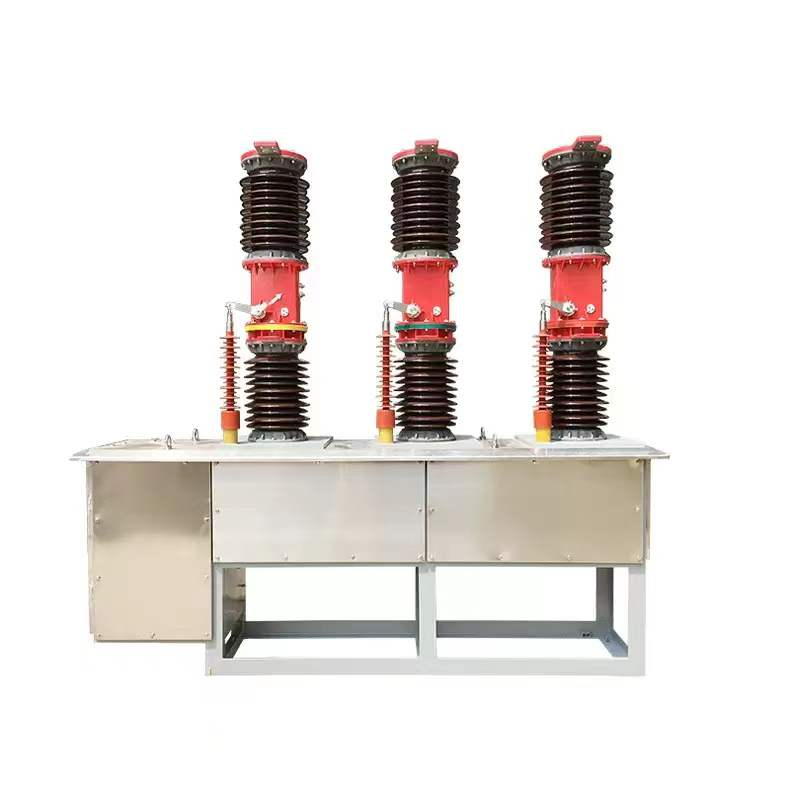
A standalone breaker: three poles on an open frame, cable terminations on the bushings, and no busbar, earthing switch or arc boundary because there is no enclosure to provide them.
The boundary between the two categories is not always clean. A ring main unit is switchgear that behaves like a breaker bay; an intelligent outdoor breaker with an integrated controller contains more protection than some lineups do. Where the choice sits between an RMU and a single breaker, the comparison in ring main unit versus vacuum circuit breaker is the one that actually gets asked.
Selection Factors For Power Projects
High Voltage Circuit Breaker Selection and HV Switchgear selection overlap but are not the same exercise, because one is choosing a device and the other is choosing a system. The table below is the shortest route through the ratings that have to be settled before either is ordered.
| Rating | What It Governs | Typical Values |
|---|---|---|
| Rated voltage | Insulation level and clearance | 12 / 24 / 36 / 40.5 kV |
| Rated normal current | Continuous loading and temperature rise | 630 / 1250 / 2000 / 2500 A |
| Short-circuit breaking current | What the device can interrupt | 20 / 25 / 31.5 / 40 kA |
| Rated peak withstand | Making onto a fault, and dynamic stress on busbars | About 2.5 times the rms value at 50 Hz |
| Short-time withstand | What the assembly survives while the fault is cleared | 20 to 31.5 kA for 1 s or 3 s |
| Internal arc class | Operator safety in front of the enclosure | IAC A or B, with a stated current and duration |
| Mechanical endurance | Life on switching duties that are not faults | 10,000 operations for class M2 |
| Degree of protection | Whether the enclosure suits the room or the weather | IP4X indoors, IP54 or IP65 outdoors |
System Configuration And Fault Duty
Count the circuits before comparing prices. One circuit with its own cable and its own protection is a breaker. Two or more circuits that have to select between each other is an assembly, because selection requires a busbar and a busbar requires an enclosure. That single question eliminates most of the specification work.
Then settle the fault duty from the network study rather than from the transformer nameplate. Motor contribution adds to the fault level for the first few cycles, and a plant with large motors can see a fault current well above what the transformer alone suggests. The chain to check is simple and one-directional: the calculated fault level must be at or below the breaker’s breaking capacity, which must be at or below the assembly’s short-time withstand. If any link is weaker than the one before it, that link sets the rating of the installation.
Busbar arrangement comes next. A single busbar is the default; a sectionalised busbar allows half the board to stay live during maintenance; a double busbar allows a circuit to be transferred without an outage and roughly doubles the cost. Choose it from the outage tolerance of the load, not from a preference for redundancy. Voltage class then follows from the network, and choosing between 12 kV, 15 kV and 38 kV metal-clad switchgear covers where the classes overlap.
Installation Conditions And Maintenance Access
The room decides more than the catalogue does, and for HV Switchgear it decides earlier than it does for a standalone breaker. An indoor assembly needs a dry, ventilated space with a cable route, a front clearance for operation, and a path for the arc ducts that does not discharge into a corridor people walk through. An outdoor breaker needs a foundation that will not settle, a pole or frame rated for the wind load, and a cable termination that can be made off in the weather.
Altitude and pollution are the two derating factors most often missed. Above the rated altitude the insulation and the current rating both fall away, and a coastal or industrial site needs a longer creepage distance than a clean inland one — which changes the insulator height and therefore the enclosure dimensions. Seismic rating matters in some regions and is a type-test property, not something that can be added on site.
Maintenance access is the decision with the longest financial tail, and it is usually made by accident. The question to ask is whether the breaker can be withdrawn or isolated without taking the busbar out of service. If it can, a single fault costs one circuit and an hour. If it cannot, the same fault costs the board and a planned outage. That is the real difference between withdrawable and fixed designs, and it dwarfs the price difference between them.
Protection, Control, And Documentation
Protection specification is where a switchgear package and a breaker package diverge most in effort. A lineup needs a relay per circuit, CTs with a defined ratio, class and burden, a DC system sized for the trip coils, an interlock scheme that covers every combination of truck, earthing switch and door, and a communications protocol that the control room already speaks. A standalone breaker needs the same decisions, but they arrive pre-made inside the controller and the buyer’s job is to verify them rather than to design them.
Documentation is the part of the purchase that gets marked complete before it is. Ask for the single line diagram, the secondary connection diagram, the terminal layout, the type test certificates including the internal arc report where an arc class is claimed, the routine test report for the actual serial number, and the as-built drawings at handover. A type test certificate that names a generic model rather than the configuration supplied is worth very little when a utility asks for it.
When a fault has already happened rather than being designed against, the diagnostic sequence in trip fault analysis and treatment is the next document, and the physical sequence from delivery to energisation is covered in the step-by-step HV Switchgear installation guide.
Size The Assembly And The Breaker Together
Send BYYOU your single line diagram, calculated fault level and circuit count, and we will confirm whether the duty needs a lineup or a standalone breaker — then quote the ratings that match, including the short-time withstand and internal arc class of the assembly.
Frequently Asked Questions
Can A Circuit Breaker Replace A Complete Switchgear Lineup?
No. A breaker interrupts current, but a lineup adds the busbar, cable termination, earthing switch, interlocks and a tested arc boundary. A breaker alone serves only a single circuit.
Which Ratings Must Be Checked Before Selection?
Rated voltage and current, short-circuit breaking current and peak making current; for the assembly, the short-time withstand current with its duration and the internal arc class.
When Is An Integrated Switchgear Solution Preferred?
When two or more circuits share a busbar, when earthing and interlocking belong inside the enclosure, or when people work in front of live parts and need a rated arc boundary.
Conclusion
The HV Switchgear VS High Voltage Circuit Breaker question resolves once you stop treating them as alternatives. A breaker is a device rated to interrupt; HV Switchgear is an assembly rated to withstand and to contain. Where one circuit is all that is needed and the site provides the earthing, a breaker is the whole answer. Where several circuits share a busbar and somebody opens a door to work, the assembly is doing work no breaker can do. High Voltage Circuit Breaker Selection is therefore a smaller question than it looks, and it is always asked second.
Talk To The Team That Builds Both
BYYOU manufactures 12 kV to 40.5 kV switchgear assemblies and the circuit breakers that go inside them — metal-clad, metal-enclosed, ring main units and outdoor breakers — with OEM and ODM support for utilities, EPCs and panel builders. Ask us which configuration your fault level actually needs.
Related Resources
- What Is Switchgear: Types And Components, A Complete Guide For Industrial Buyers
- 7 Main Types Of High Voltage Switchgear Used In Power Systems
- Complete Guide To High Voltage Switchgear In 2026
- Metal-Enclosed Switchgear: Definition, Types And Applications
- Metal-Clad Switchgears: Definition, Benefits And Applications
- Different Types Of Vacuum Circuit Breakers
- How Long Does High Voltage Switchgear Last: Lifecycle And Maintenance


