

How Auto Reclosers Improve Reliability of Main Power Grid Lines
Most unplanned outages on main power grid lines are not caused by permanent damage. They are triggered by temporary events – a tree branch brushing a conductor, a lightning-induced surge, or animal contact – that clear themselves within seconds. An Auto Recloser is the device that tells the difference. Installed on overhead distribution feeders, it automatically detects a fault, interrupts the current, and then re-closes after a short delay to test whether the fault has disappeared. When the fault was transient, power is restored in moments instead of after a crew is dispatched.
This article explains how automatic reclosers improve the reliability of main power grid lines, where they are applied, what to evaluate before specifying one, and why the choice of manufacturer matters for decades of network performance. Explore our full range of Auto Recloser products built for 10-35kV distribution networks.
How Auto Reclosers Improve Reliability Of Main Power Grid Lines
A recloser sits between the source and the load as an intelligent, self-acting switch. Its value to grid reliability comes from five reinforcing functions.
2.1 Automatic Fault Detection And Fast Power Restoration
An automatic recloser continuously monitors phase and residual currents through integrated sensors. The instant it senses a fault current above the preset pick-up value, the control unit trips the interrupter and opens the circuit. After a programmed dead time – typically 0.5 to 5 seconds – the recloser automatically closes to test the line. If the fault was transient, normal load current resumes and the event is logged; if it persists, the device advances to the next reclose attempt. Modern units complete the detect-trip-reclose-restore cycle in seconds, which is the single biggest contributor to reduced customer interruption time on main grid lines.
2.2 Reducing Power Interruptions Caused By Temporary Faults
Field data consistently shows that 70-90% of overhead-line faults are temporary. A power line recloser is purpose-built for exactly this reality: it absorbs the transient fault, restores service automatically, and only locks out when a fault is genuinely permanent (for example, a broken conductor). By avoiding a truck-roll for every transient event, utilities cut sustained interruption frequency and keep SAIDI and SAIFI metrics under control. For a closer look at how recloser type affects this behavior, see our guide on three phase vs single phase auto recloser applications.
2.3 Improving Distribution Grid Reliability And Stability
A Distribution Recloser does more than restore a single feeder. When coordinated with upstream protection and downstream fuses, it isolates only the faulted segment and keeps the rest of the network energized. In automated distribution systems, groups of reclosers communicate through FTU and SCADA to achieve self-healing – automatically rerouting power around a fault. The result is a distribution grid that is both more reliable and more stable under disturbance.
2.4 Enhancing Protection Coordination In Power Networks
Within a recloser in power system architecture, coordination is everything. Reclosers support selectable trip curves (inverse-time, definite-time, and programmed multi-shot sequences) so they trip before upstream breakers for line faults, yet defer to downstream fuses for lateral faults. This zone-selective operation prevents cascading outages and lets engineers tune the network for both speed and selectivity. Proper coordination also reduces mechanical duty on expensive substation equipment.
2.5 Improving Maintenance Efficiency And Reducing Operating Costs
Every automatic restoration is one fewer emergency dispatch. By handling transient faults without field crews, a recloser directly lowers operating expenditure and improves crew safety during storms. Remote monitoring through the intelligent controller means most diagnostics – event records, fault location, and breaker status – are available from the control room. That shifts maintenance from reactive to planned, extends equipment life, and cuts lifecycle cost.
Need a reliable Auto Recloser for your main power grid lines?
BEIYE ELECTRIC manufactures certified Auto Recloser solutions for 10-35kV distribution networks, with strict quality control and full after-sales support. Get a tailored quotation from our engineering team.
Key Applications Of Auto Reclosers In Power Grid Systems
Auto reclosers are deployed wherever overhead or mixed overhead/underground distribution meets transient-fault exposure:
- Overhead main power grid lines and rural radial feeders
- Urban and suburban distribution networks
- Renewable integration points such as solar and wind collection feeders
- Industrial plants and campus power systems
- Substation outgoing feeders and ring-main loops
- Mountainous or vegetation-heavy corridors with high fault exposure
Factors To Consider When Selecting Auto Recloser For Power Grid Applications
Specifying the right unit protects grid reliability for 15-30 years. Use the quick-reference table below to match parameters to your network, then validate against a coordination study.
| Parameter | What to verify | Why it matters |
|---|---|---|
| Rated voltage | 10-35kV, matches system nominal and BIL | Safe, certified interruption |
| Current & breaking capacity | Load plus fault current (e.g., 630A / 20-25kA) | Clears faults without damage |
| Mechanism type | Permanent-magnet vs spring | Maintenance and reliability profile |
| Control & communication | FTU, SCADA, GPRS / fiber | Automation and remote operation |
| Insulation / enclosure | Polymer solid-sealed pole | Moisture and pollution resistance |
| Certifications | Third-party type tests | Compliance and tender eligibility |
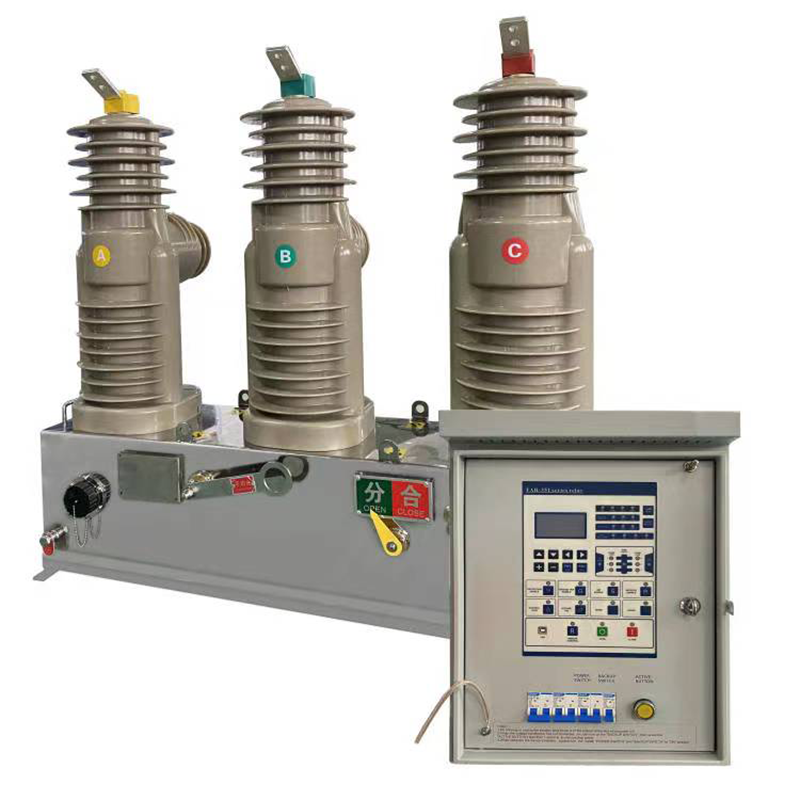
For a deeper checklist, read our guide on how to choose the right recloser. Our BZX32-24/630-25 Vacuum Auto Recloser is a 24kV, 630A pole-mounted unit with a permanent-magnet mechanism and integrated FTU – representative of the build quality expected for main-grid duty.
Why Choose A Reliable Auto Recloser Manufacturer
Two reclosers with identical nameplate ratings can deliver very different 20-year outcomes. Manufacturer discipline is what separates them.
- Verified quality system: BEIYE ELECTRIC controls every step from raw material to final test, and products are certified by authoritative testing institutions.
- Proven track record: supply experience to CSG and SGCC, with completed projects across energy, metallurgy, and industrial manufacturing.
- Engineering depth: a technical team with 15+ years in medium- and high-voltage switchgear.
- Lifecycle support: OEM and ODM service, after-sales support, genuine spare parts, and firmware or coordination assistance.
Choosing a manufacturer with this depth turns a commodity purchase into a long-term reliability partnership.
Specifying a recloser for a power grid project?
Talk to the BEIYE ELECTRIC engineering team for model selection, coordination support, and a project quotation tailored to your network voltage and fault levels.
FAQ
What Types Of Faults Can Auto Recloser Clear?
An auto recloser clears both transient and permanent faults up to its interrupting rating. Transient faults – lightning surges, temporary vegetation contact, and animal bridges – are cleared automatically and power is restored. Permanent faults such as broken conductors or failed equipment are isolated by locking out the faulted section.
How Often Should Auto Recloser Be Maintained?
A visual inspection is typically recommended every 1-2 years, while a full program of electrical testing, mechanism lubrication, and control-battery checks is usually performed every 4-6 years, depending on switching duty and environment. Always follow the manufacturer’s specific schedule.
How Does A Distribution Recloser Reduce Power Outages?
A distribution recloser automatically re-closes after a transient fault, restoring power in seconds without a crew. It also limits the outage to the faulted zone through selective coordination, so the rest of the feeder stays energized.
What Are The Key Components Of A Recloser In Power System?
The core components are the interrupter (typically vacuum), current and voltage sensors, the operating mechanism (permanent-magnet or spring), and the intelligent control unit or FTU that handles protection, communication, and event recording.
How Long Does Automatic Recloser Restore Power After Fault?
For a transient fault, restoration is usually achieved within a few seconds – often 1 to 5 seconds per reclose attempt – once the fault clears, far faster than any manual crew response.
What Is The Difference Between Auto Recloser And Circuit Breaker?
A circuit breaker trips once and stays open until manually or remotely reset. An auto recloser repeats the trip-close sequence automatically, attempting restoration before locking out, which makes it ideal for overhead lines with transient faults.
What Factors Should Be Considered When Selecting Power Line Recloser?
Evaluate rated voltage and BIL, load and breaking current, mechanism type, control and communication capability, enclosure and insulation class, and third-party certifications – then confirm coordination with upstream and downstream devices.
Conclusion
An Auto Recloser is one of the highest-return investments in main power grid reliability: it converts transient faults into non-events and keeps permanent faults from cascading. By combining fast automatic restoration, selective protection coordination, and remote diagnostics, a Distribution Recloser reduces outages, operating cost, and crew risk at once. For project-specific selection and a quotation tailored to your network, contact the BEIYE ELECTRIC engineering team today.


