


Auto Recloser vs Load Break Switch: 5 Key Differences And How To Choose
Two devices hang on the same pole, both are sold as switches, and both datasheets print a number in the twenties followed by kA. That is where most specifications go wrong. An Auto Recloser and a Load Break Switch do different jobs with different ratings, and the gap between them is not a matter of degree. One interrupts fault current and restores supply by itself. The other switches load and isolates a section so people can work on it. This guide sets out the five differences that decide the choice, using ratings from real datasheets.
Auto Recloser VS Load Break Switch: 5 Key Differences
Both are three-phase medium-voltage devices with an operating mechanism and a set of contacts. Beyond that the similarity is superficial. The table below is the short version; each difference is explained in the sections that follow, with the numbers that make the comparison concrete.
| Criterion | Auto Recloser | Load Break Switch |
|---|---|---|
| Primary duty | Interrupt fault current, then restore supply automatically | Make, carry and break load current, then isolate |
| Fault-interrupting rating | Yes — 25 kA breaking current at 24 kV | No — 20 kA is a 4 s withstand, not a breaking rating |
| Automatic reclosing | Programmable, up to three shots then lockout | None — opening ends the event |
| Protection | Numeric relay in the controller, curves and event records | Current-limiting fuse in the switch-fuse version |
| Mechanical life | 30,000 operations | 2,000 operations |
| Typical position | Feeder head, tie point, long exposed lateral | RMU branch, transformer spur, sectionalising point |
| Relative capital cost | Higher | Lower |
Definition
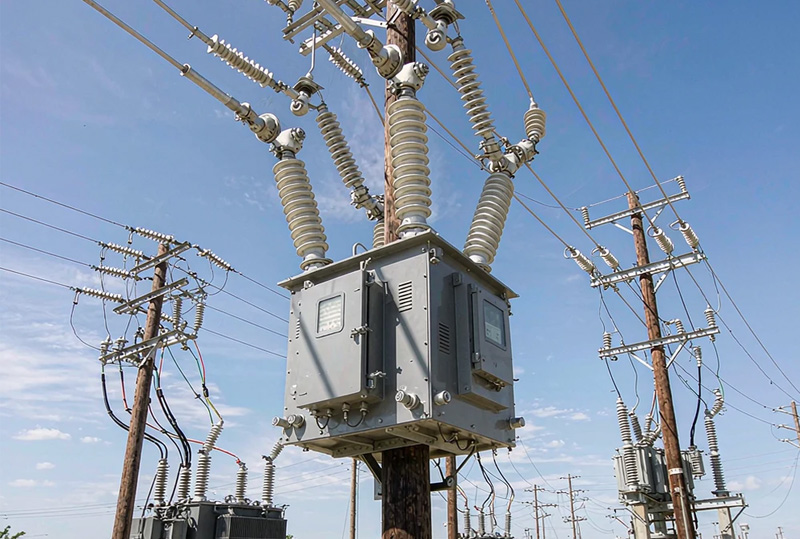
An Auto Recloser — formally an Automatic Circuit Recloser — is a self-contained protective device for overhead and pad-mounted distribution networks, standardised under IEC 62271-111 and IEEE C37.60 for systems up to 38 kV. Physically it is a vacuum interrupter inside a sealed pole or tank, current transformers for measurement, a magnetic or spring actuator, and a controller that holds the protection logic and the reclosing sequence. The interrupter does the switching; the controller does the thinking. Every pole-mounted unit in the BYYOU Auto Recloser range follows that architecture.
A Load Break Switch is a switching device. It is rated to make, carry and break load current, to carry fault current for a stated time without damage, and to close onto a fault without welding its contacts. It is standardised under IEC 62271-103. What it does not have is a fault-interrupting rating. Where the switch is combined with a current-limiting fuse under IEC 62271-105, the fuse does the interrupting and the switch provides the isolation. The BYYOU Load Break Switch range is built on exactly that model: switch, earthing switch and fuse on one frame, mechanically interlocked.
The distinction that matters commercially is simpler than the standards. The switch is closer to a load-rated isolator than to a circuit breaker. It is built to be operated a few times a day to reconfigure a network, and then to sit closed for months. The recloser is built to operate into faults repeatedly and to keep doing it between services.
One related device gets mixed into the same conversation and is worth separating out. A sectionalizer counts fault-current pulses and opens during an upstream device’s dead time; it has no breaking rating at all and cannot work alone. A Load Break Switch, by contrast, is operated deliberately — by a handle, a motor, or a remote command — and it can break the load current it is rated for. If the requirement is automatic sectionalising, neither of the two devices in this comparison is the answer.
Fault Interruption Capability
This is the difference that governs everything else, and it is the one buyers most often misread. Both datasheets print a figure in the low twenties followed by kA. On an Auto Recloser, 25 kA is a breaking rating: the device has been type-tested to extinguish an arc while that current is flowing, and to recover its dielectric strength before the transient recovery voltage restrikes. On a Load Break Switch, 20 kA is a withstanding rating: the device has been type-tested to carry that current for four seconds without damage while something upstream clears the fault.
Those two numbers describe opposite duties, and confusing them is not a paperwork error. A switch rated 20 kA for 4 s and then asked to open on a 20 kA fault is being operated outside its type test. That is an arc-flash event, not a switching operation.
The rest of its rating sheet tells the same story. Its breaking ratings are load-shaped: 630 A of active load current, 630 A of closed-loop current for ring transfer, 31.5 A at 5% power factor, 10 A of cable charging current, and the magnetising current of a 1250 kVA no-load transformer. Its making current is 50 kA peak, which means it can be closed onto a fault without its contacts welding — but it still cannot open one.
There is a detail in the insulation table that shows the design intent. Across the isolating gap the switch withstands 48 kV, while phase-to-earth it withstands 42 kV. The gap is rated higher than the insulation to earth because the gap is expected to hold off system voltage with the switch open. That is an isolating duty, and it is why the same device can be locked open for line work.
What happens in practice: a fault downstream of a Load Break Switch is cleared by the breaker or Auto Recloser upstream. The switch then opens in a de-energised window, or is opened later for isolation. It never sees the fault current at all — which is exactly what it was designed for, and a large part of why it costs less.

Automatic Reclosing And Restoration
Most faults on an overhead line are temporary. A branch touches a conductor, a bird bridges two phases, lightning flashes across an insulator — the fault clears itself in a few cycles, and the line would run perfectly if someone simply closed the device again. Utilities typically find that 70–80% of overhead faults clear on the first reclose. That statistic is the entire commercial case for an Auto Recloser, and it explains why the value of a single reclose is far larger than the unit price suggests. The mechanism is set out in our guide to how Auto Reclosers improve reliability on main grid lines.
The sequence is programmable, and the datasheet states the rated one: O-0.1 s-CO-0.1 s-CO-0.3 s-CO. Read it as open, wait 0.1 s, close and open again, wait 0.1 s, close and open again, wait 0.3 s, close. Three attempts inside a second, then lockout if the fault is still there. Dead time per shot, reset time and the number of shots are all settings — and so are inrush restraint and cold load pickup, the two functions that stop a controller from tripping on the current a whole suburb draws when the supply returns after an outage.
A Load Break Switch does none of this. Opening is the end of the event until a person acts. A motor-operated unit with an RTU can be closed remotely, but that is manual restoration with a communication delay in front of it, not automatic restoration. The difference is measurable: a 0.3 s dead time against a crew dispatch, a drive and a switching sequence — call it 45 minutes on a good day, and hours in the weather that caused the fault.
Protection Method: Relay Versus Fuse
An Automatic Circuit Recloser contains a small numeric relay. The controller on the BZX32-24/630-25 carries 50/51 phase overcurrent, 50N/51N earth fault, 50G/51G ground fault and sensitive earth fault, 46 current unbalance and 79 reclosing. Curves are selectable between IEC and ANSI families, each shot can carry its own settings, and every operation is time-stamped with the fault current that caused it. That record is what makes post-fault analysis possible at all.
A Load Break Switch contains no protection. In the switch-fuse version — a solid-seal switch-fuse combination built to IEC 62271-105 — a current-limiting fuse does the interrupting, at 31.5 kA, and the switch provides the isolation. The fuse carries a striker with 1 ± 0.5 J of output energy. When the fuse operates, the striker trips the switch so all three poles open together.
That last detail matters more than it looks. Without it, one blown fuse leaves the other two phases live and single-phases every motor downstream. The combination also carries a rated transfer current of 1200 A, which is the current it can commutate to the fuse without damage — a reminder that a switch-fuse combination is a tested system, not two parts in a box.
The trade-off runs both ways. A fuse is single-shot: after it operates the circuit stays dead until someone replaces it with the correct rating from stock. It cannot do earth fault, it cannot be shaped by curve coordination beyond selecting a rating, and it records nothing. A relay can do all of that, but it needs a protection study, a battery and an engineer who can read a time-current curve — and it will hold a setting that was correct for a network that has since been reconfigured.
Operating Duty And Endurance
The two datasheets disagree by a factor of fifteen on mechanical life: 30,000 operations for the Auto Recloser, 2,000 for the Load Break Switch. That is not a quality difference. It is a statement about the duty each device is expected to survive.
An Automatic Circuit Recloser at a feeder head on a lightning-prone line can log 30 to 50 trip operations in a year, most of them cleared on the first reclose. Over a 20-year life that is 600 to 1,000 fault interruptions, each eroding a little contact material inside the vacuum bottle, plus a far larger number of load operations. Thirty thousand is sized for that, which is also why the maintenance schedule that extends service life is driven by operations rather than by the calendar.
The switch is sized for a different pattern: a handful of deliberate operations a week at most, most of them at or below rated load current, and long idle periods closed. Two thousand operations is roughly two decades of that. Put the same switch where it must interrupt faults and it will not reach a fraction of its mechanical rating, because the contacts and the arc-control chamber will be gone long before the mechanism is.
The rated operating sequence belongs to the same argument. O-0.1 s-CO-0.1 s-CO-0.3 s-CO is a tested sequence: three close-open operations inside a second, at rated current. The switch has a making rating that covers closing onto a fault, but no equivalent sequence rating. The expectation is that it closes once onto a fault, holds, and is inspected afterwards.
Cost And Lifecycle Economics
On capital cost the Load Break Switch wins, and it is not close. The difference is not in the contacts or the frame. It is in everything an Auto Recloser needs in order to think: current transformers, a voltage source, a controller, a battery, a communications module, and the engineering time to set it all up. The switch is a mechanism, a set of contacts and, optionally, a fuse.
That structure carries into operating cost, and here the switch has a genuine advantage that buyers tend to underestimate. There is no battery to replace, no firmware to manage, no protection settings to review when the network changes, and nothing to reprogram after a fault. On a remote rural spur that is worth a great deal: the device that needs no visit is the device that keeps working.
But the comparison is not device against device. It is scheme against scheme. The switch cannot clear a fault, so every fault on its section is cleared by something upstream — which means every transient fault on that section becomes a sustained interruption. Where the section serves a production line, a water treatment works, or a few hundred households on a SAIDI target, the cost of those interruptions never appears in the capital comparison, and it usually exceeds the price difference within two or three years.
The honest way to run the numbers: count the transient faults per year at that point on the feeder, multiply by the cost of an outage to the customer or the penalty to the utility, and compare that annual figure with the annualised capital gap plus battery and controller maintenance. When the answer is close, the recloser usually still wins, because the reliability benefit keeps accruing while the price gap is paid once. If the answer is a recloser, the seven factors that decide the model are a separate exercise from deciding the device.
Send Us The Single-Line Diagram And Fault Level
Our engineering team will mark which positions need fault interruption and which are switching duty only, then quote the devices that match — Auto Reclosers, Load Break Switches, or both. Send the single-line diagram, the prospective fault current at each point of installation, and whether the feeder is overhead or cable.
How To Choose
Selection comes down to four questions, and they are best answered in order. The first one decides the device; the other three decide the model and the accessories.
Confirm Whether Automatic Restoration Is Required
This is the decisive question, and it is usually answerable in one meeting. If the answer is yes, nothing else on this page matters, because a Load Break Switch cannot do it — at any price, with any accessory, in any enclosure.
Automatic restoration is required when the supply is overhead and exposed. Lightning, vegetation, birds, wind-blown debris and insulator contamination all produce faults that clear themselves, and those are exactly the faults a reclose recovers. It is also required when the customer cannot absorb a manual restore: a production line that scraps a batch on every interruption, a pumping station that needs a sequenced restart, or a utility that reports SAIDI and SAIFI and is judged on them.
It is not required when the fault is cleared somewhere else anyway. Inside a ring main unit, the Load Break Switch’s job is to switch and isolate — protection sits at the substation, and a recloser in the RMU branch would duplicate it. It is not required on a cable-fed spur, where faults are permanent by nature and a reclose into a cable fault does nothing except stress the network a second time. And it is not required where a fuse already protects a small transformer correctly.
One practical note: a reclose into a permanent fault is not free. Each shot puts the network through a full fault cycle, and on a cable system or a transformer-fed section that is stress with no upside. Reclosing belongs on overhead lines. On cable it belongs switched off.
| Situation | Device | Why |
|---|---|---|
| Overhead rural feeder head | Auto Recloser | Transient faults dominate, and a reclose restores most of them |
| Long lateral with branches | Auto Recloser | Restores the main line and keeps a branch fault local |
| Tie point between two sources | Auto Recloser | It must close into a live fault and still be able to trip |
| RMU branch or ring position | Load Break Switch | Switching and isolation duty; protection is upstream |
| Cable-fed industrial spur | Load Break Switch | Cable faults are permanent, so reclose adds stress and no benefit |
| Transformer spur up to 1250 kVA | Switch-fuse combination | The fuse clears, the switch isolates, the striker prevents single-phasing |
Match Breaking Capability To Fault Level
This is where the 20 kA trap does its damage. The question is not what kA appears on the datasheet. It is whether this device must interrupt the prospective fault at its terminals, or carry it until something else does.
If it must interrupt, the breaking current has to exceed the prospective fault at the point of installation, not at the substation bus. Fault level falls with distance and conductor size, so a device 12 km down a small-conductor lateral may see less than half the bus value. The operating sequence has to be adequate as well: a device rated for a single break is not the same as one rated for three breaks in a second. Voltage class follows the same logic, and the comparison of 11 kV, 33 kV and 40.5 kV outdoor breakers walks through the classes and their fault levels.
If it only has to carry, two ratings matter and a third is usually forgotten. The short-time withstand must exceed the prospective fault for as long as the upstream protection takes to clear — the FN12-12D is rated 20 kA for 4 s, which covers even a slow upstream backup. The making current must exceed the peak, which on a 50 Hz system with full DC offset is roughly 2.5 times the rms value, so 20 kA becomes 50 kA peak. The forgotten one is the X/R ratio: a highly inductive industrial feeder produces more DC offset, and the peak that actually arrives is higher than a symmetrical calculation suggests.
Check the minimum fault current too, not just the maximum. It matters for anything with a sensing element, and it matters for fuse selection: a fuse that is too large will not clear a remote fault, and one that is too small will operate on motor starting.
| Rating | Auto Recloser | Load Break Switch | What It Decides |
|---|---|---|---|
| Rated voltage | 24 kV maximum | 12 kV | Must exceed the system maximum, with insulation margin |
| Rated current | 630 A | 630 A, or 125 A with fuse | Must exceed the load current, allowing for growth |
| Breaking current | 25 kA | None, or 31.5 kA through the fuse | Only the recloser can interrupt a fault at its own terminals |
| Short-time withstand | Covered by the breaking rating | 20 kA for 4 s, earth switch 20 kA for 2 s | Carry time must exceed the upstream clearing time |
| Making current | Rated with the interrupter | 50 kA peak | Closing onto a fault must not weld the contacts |
| Mechanical life | 30,000 operations | 2,000 operations | Must match the duty at that position, not the average |
| Ingress protection | IP65, stainless enclosure | Set by the enclosure it is installed in | Outdoor units need a genuine IP rating, not a cabinet claim |
Compare Control Power And Automation Needs
An Automatic Circuit Recloser is an automation device, and automation devices need power. The controller runs on a DC auxiliary supply — commonly 24, 48, 110 or 220 V — with a battery typically sized for 24 to 48 hours of standby so the unit can still trip and reclose after the station battery or the local supply is lost. Current transformers provide measurement; a voltage source, often a capacitive divider or a small PT, provides polarisation and voltage-based logic. Without an auxiliary supply there is no protection, only a manual mechanism.
A Load Break Switch needs none of that. It is operated by a handle, or by a motor that runs only when a command arrives. If it has to report its position to a control centre it needs an RTU and a communications link — and at that point the cost advantage narrows sharply, because you have bought most of the automation without buying any fault interruption.
Protocol choice is a specification item, not an afterthought. The BZX32-24/630-25 speaks DNP3.0 over USB, RS232 or Ethernet; larger schemes commonly ask for IEC 60870-5-104 to a control centre or IEC 61850 inside a substation. Whatever the protocol, the point is the same: a device that reports fault current and trip history gives a distribution management system something to work with, and a device that reports only open or closed does not. If the utility runs FLISR, that distinction decides which device can be a node in it.
Compare Isolation Duty And Maintenance Needs
The Load Break Switch’s strongest argument is not cost. It is that the device is built to be made safe. The FN12-12D opens onto a designed isolating gap — 48 kV across the gap against 42 kV to earth — and carries an earthing switch rated 20 kA for 2 s, with mechanical interlocks between the switch, the earthing switch and the fuse that enforce the operating sequence. That combination is what lets a crew lock the device open, earth the section and work on it. The difference between a circuit breaker and an isolation switch is the cleanest way to see why that duty is separate from interruption.
An Auto Recloser cannot do that job. It is a sealed stainless enclosure rated IP65 with no visible break, so isolating a section for line work needs a separate isolator or a visible-break switch ahead of it. That is not a weakness in the recloser; it is the boundary of its purpose.
Maintenance follows the same split. The switch needs an inspection, a contact check, a mechanism exercise and a fuse stock — and the interlocks need testing, because an interlock that has been defeated is worse than no interlock at all. A recloser adds a battery with a finite life, controller firmware, CT and PT checks, a post-fault interrupter inspection after a heavy fault, and a protection settings review every time the network around it changes. None of that is difficult. All of it is a schedule that has to exist.
There is a design consequence worth stating plainly: these two devices are complementary, not competing. A feeder head with an Auto Recloser and a Load Break Switch with an earthing switch downstream of it gives both automatic restoration and a safe point to isolate, which is how most well-designed overhead schemes are actually built.

Frequently Asked Questions
Which Standards Apply To Each Device?
Auto Reclosers follow IEC 62271-111 and IEEE C37.60 up to 38 kV. Load Break Switches use IEC 62271-103; switch-fuse combinations add IEC 62271-105, with IEC 62271-1 as the common clause.
What Ratings Must Be Confirmed Before Ordering?
Confirm voltage, rated current and whether the device must break fault current or only withstand it: breaking current for a recloser, short-time withstand and making current for a switch.
What Tests Should Be Run Before Energising?
Check insulation resistance, contact resistance and mechanical operation, verify trip and close coils at 85% and 110% of rated voltage, CT ratio and polarity, relay injection and every interlock.
Conclusion
The Auto Recloser VS Load Break Switch decision is settled by one question, asked early: must this device interrupt a fault, or only switch and isolate? Answer yes and the choice is an Auto Recloser, with its 25 kA breaking rating, its three-shot sequence and its relay. Answer no and a Load Break Switch does the job for less, with an isolating gap and an earthing switch that make the section safe to work on. Most good schemes use both, in the positions where each one earns its place.
Specify The Right Device The First Time
BYYOU manufactures 12 kV and 24 kV pole-mounted Auto Reclosers and the full Load Break Switch range — compressed-air, vacuum and switch-fuse combinations — for utilities, EPC contractors and panel builders, with OEM and ODM support. Send your ratings and we will return a specification you can tender against.
Related Resources
- What Is the Difference Between a Load Break Switch and a Vacuum Circuit Breaker
- Recloser vs Circuit Breaker: Which One Is Better for Your Business
- Auto Recloser Function and Working Principle in Power System
- Three-Phase vs Single-Phase Auto Recloser: Applications and Selection Guide
- How to Tell if a Vacuum Auto Recloser Is Open or Closed
- Ring Main Unit (RMU) vs Vacuum Circuit Breaker (VCB)
- Reclosers in Power Systems: Applications, Benefits and Selection Tips


