


RMU Maintenance Checklist: Visual, Interlock, and Functional Checks
A Ring Main Unit is sold as maintenance-free, and for the sealed insulation that is broadly true. The parts that fail are the ones nobody sealed: a cable interface that has been tracking for two years, a door gasket that took a permanent compression set, an interlock somebody defeated to save an afternoon. None of them announce themselves. This RMU Maintenance Checklist covers what a technician should actually look at, what the approved plan requires you to test, and how to close a defect so the next inspection starts from a baseline instead of an opinion.
RMU Maintenance Checklist: Visual, Interlock, And Functional Checks
The sequence matters more than the list, and a workable RMU Maintenance routine always runs in this order. Records come first, because an inspection without a baseline is a set of opinions. The visual pass comes second, because it costs nothing and finds most defects. The interlock and functional checks come last, because they are the only ones that prove the unit will behave correctly when somebody operates it under pressure.
Six stages, in this order:
| Stage | What It Establishes | Evidence It Passed |
|---|---|---|
| Records | What normal looks like for this specific unit | Factory report and last inspection sheet in hand |
| Enclosure and labels | Whether the barrier and the instructions still work | Photograph of nameplate and IAC label |
| Mechanism | Whether the unit will actually operate | Counter reading and a clean manual operation |
| Interlocks | Whether it will refuse the wrong operation | A recorded attempt at each forbidden operation |
| Tests | Whether insulation and contacts are still in specification | Measured values against the baseline |
| Records again | Whether the next inspection has a starting point | Closed defects and an updated trend sheet |
Equipment And Installation Records
Before anyone opens a door, establish what normal looks like for this unit. The handover pack from the RMU Installation stage is that baseline: the factory routine test report carrying insulation resistance, contact resistance, timing and gas tightness; the commissioning sheet with the values recorded after the cables were terminated; the as-built single line diagram; and the foundation and cable entry drawings. Without them a reading of 400 MΩ means nothing, because there is nothing to compare it against. The sequence that produces those numbers is set out in our step-by-step HV switchgear installation guide, and the test sheet is the part of it worth filing.
Verify the nameplate against the drawing before you test anything. Rated voltage, rated current, short-circuit rating, internal arc classification, IP rating, year of manufacture and serial number all have to match the asset register. If the unit on site is not the unit on the drawing, every comparison that follows is being made against the wrong reference, and the mistake usually surfaces years later when somebody tries to order a spare.
Three records go missing more often than the rest: the gas filling record for a sealed unit, the torque values used on the cable lugs, and the protection settings actually left in the relay as opposed to the settings calculated. Each is cheap to keep and expensive to reconstruct. Where they do not exist — common on a site that has changed maintenance contractor twice — the first inspection has to create the baseline, and it should be more thorough than a routine one, not less. Photograph the nameplate, the IAC label and the gas plate, record the operation counter, and treat every measured value as a first data point rather than a pass or a fail.
Enclosure, Labels, And Cleanliness
Corrosion starts where water sits, which is the base frame, the bottom edge of the door and the hinge pins. A door gasket that has taken a permanent compression set still looks present and no longer seals; press it and see whether it springs back. Hinge wear shows as a door that drops on its corner or rubs the frame, and a door that no longer closes squarely has quietly cancelled the IP rating that the enclosure was bought for.
An enclosure rating is not a washing instruction. Under IEC 60529 the second digit of the IP code describes water, and an enclosure rated IP4X has no water rating at all because the X means that digit was never tested. Hosing down a switchroom, or wiping insulating surfaces with a wet cloth, pushes moisture into exactly the places the design kept dry. Use a dry lint-free cloth, keep solvents away from epoxy and cast resin, and vacuum conductive dust rather than blowing it around.
Moisture control is the highest-value RMU Maintenance item in any switchroom, and it starts with the heater. Check that it actually heats rather than that it is simply present, and check the thermostat setting while you are there. The classic omission is a heater on the incomer and none on the ring switches that sit idle for months: a circuit that never carries load never warms itself, and that is where the condensation lands.
Labels are functional equipment, not decoration. Feeder designation, warning labels, the internal arc classification label, the operating sequence instructions, the earthing point marking and the phase colours all have to be legible, because the next person operates from them and may never have seen this room before. An illegible label is a defect. So is a label that no longer matches the as-built drawing after a modification, which is the more dangerous of the two.
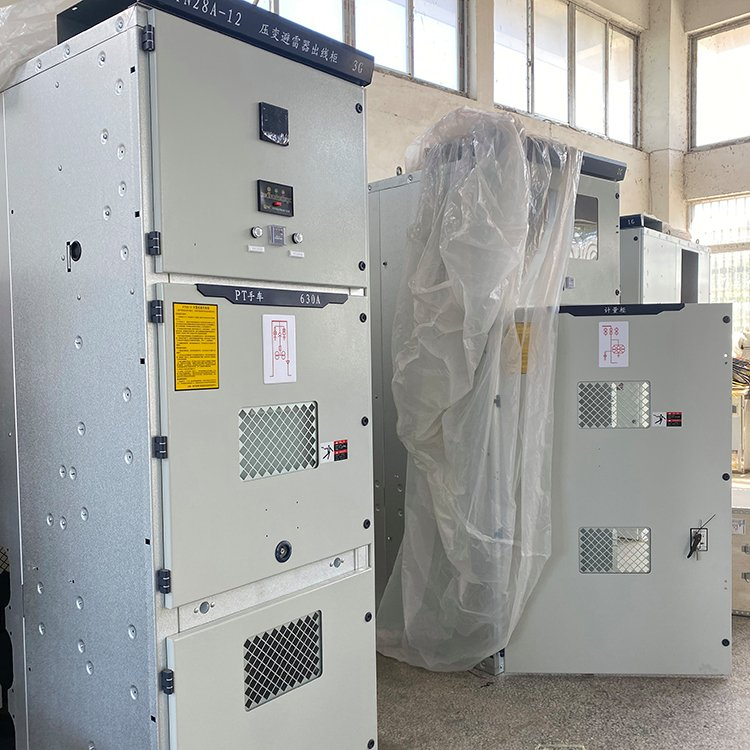
What the visual pass is looking for: legible labels, a nameplate that matches the drawing, and a compartment that has stayed dry.
Operating Mechanisms And Position Indicators
A position indicator is a claim, not a measurement. It is a mechanical linkage to the operating shaft, and it can be wrong. Verify position by operating the unit and confirming the indication changes with it, and where the design gives a direct view of the contact or earth position, use that view rather than the flag.
Manual operation should feel smooth and consistent, and it should feel the same as the sister units in the same room. Stiffness is a symptom — lubrication loss, misalignment, a spring losing its charge — and the wrong response is to work it free. Compare, then investigate. On a spring mechanism, watch the charge, listen for the latch, and confirm the trip releases cleanly. On a motor-operated unit, record the charging time and the motor current; both drift before the mechanism actually fails.
Read the operation counter and write it down. A circuit breaker built to mechanical class M2 under IEC 62271-100 is rated for 10,000 mechanical operations, and a load break switch carries its own figure from IEC 62271-103. The counter tells you where the unit sits in its life and, more usefully, whether the duty it is seeing matches what the design assumed. A ring switch showing three times the operations of its neighbours is telling you something about the network, not about the switch.
Auxiliary contacts deserve the same attention as the main mechanism. Confirm that each contact changes over in both positions, because a sticking auxiliary makes the remote indication lie, and an operator who trusts a lying indication will eventually operate the wrong way. The same discipline applied to outdoor breakers is covered in our note on extending equipment life through operating practice.
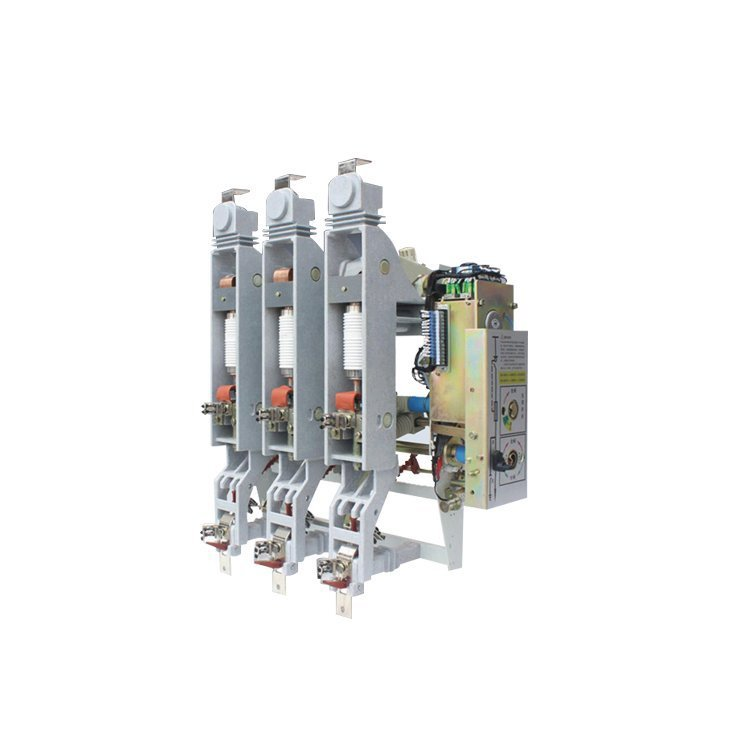
The mechanism a technician actually inspects on a withdrawable unit: spring charge, latch, trip linkage and the auxiliary contact block on the right.
Model-Specific Interlocks And Auxiliary Circuits
Interlocks are the part of an RMU that gets defeated most often, because bypassing one is quick, invisible and occasionally convenient. A defeated interlock passes every visual inspection ever written. The only way to know it works is to attempt the forbidden operation deliberately, at reduced energy where the procedure allows, with the unit earthed where it does not, and to write down what happened.
On the HXGN metal-enclosed range the chain has five links: the vacuum interrupter interlocked with the isolating knife, the isolating knife interlocked with the grounding knife, both interlocked with the cabinet door, and the insulating partition interlocked with the door so the door cannot open until the partition is in place. Five links means five separate attempts. Testing the door and calling the interlock verified is how a chain gets signed off with a broken link in the middle. The arrangement is documented on the HXGN switchgear page.
A metal-clad withdrawable unit such as the KYN28-12 works differently, and the difference is worth understanding before you test it. The truck cannot be racked with the breaker closed; the earthing switch cannot be closed unless the breaker is in the test or disconnected position; the breaker cannot be closed while the earthing switch is closed; and the shutters close automatically as the truck withdraws. If your team maintains both types, the comparison in metal-clad versus metal-enclosed switchgear explains why the interlock sets differ.
Sealed units change the scope rather than the principle. On the SH-SRM-12 the interlocking sits inside a sealed assembly and the gas compartment is not user-serviceable, so the checks reduce to the operating interface and the pressure or density indication. On the SHAir-12 dry-air and the GTXGH solid-insulated platforms there is no gas to top up at all, which moves the routine entirely onto the mechanical and electrical side. The one thing that does not change is that the interlock still has to be attempted, not admired.
Auxiliary circuits carry the same risk in a quieter form. Check CT and PT secondary wiring for tightness and for a single-point earth that is still single, measure trip coil resistance against the previous value, confirm anti-pumping, read the relay flags and clear them only after they are recorded, and verify that every point the SCADA system displays still corresponds to a real input. A remote indication that has been wrong for six months is worse than no indication, because the control room has been making decisions on it.
Tests Required By The Approved Maintenance Plan
An approved RMU Maintenance plan decides which tests are done, not the technician and not the instrument that happens to be in the van. The useful discipline is to insist that every test in the plan carries a pass criterion and a source for that criterion — the factory report, a standard clause, or the previous result. A test without a criterion produces a number, not a result.
| Test | Instrument | Where The Criterion Comes From |
|---|---|---|
| Insulation resistance | 5 kV insulation tester | Previous result and factory report |
| Contact resistance | Micro-ohmmeter | Factory value and phase balance |
| Timing and travel | Breaker analyser | Manufacturer’s curve |
| Gas moisture and purity | Gas analyser | IEC 60480 and the manual |
| Leakage | Leak detector, pressure against temperature | IEC 62271-1 rate |
| Partial discharge | TEV and ultrasonic detector | Site background level |
| Thermography | Thermal imager, under load | Phase balance at the same current |
| Protection | Secondary injection set | Approved settings file |
| Control supply | Battery load test | Manufacturer’s capacity figure |
Insulation resistance is the test everyone runs and the one most often misread. On 12 kV equipment a 5 kV DC tester is normal practice, and a dry, clean circuit reads in the hundreds of megohms or higher. The absolute number matters far less than the direction of travel: a value that has halved since the last inspection is a finding even if it is still high, because insulation does not recover on its own and the cause — moisture, dust, a degraded cable interface — is still there.
Contact resistance is best read as a comparison rather than a figure. Measure all three poles at the same temperature and look for the one that is out of line with its sisters, then compare it against the factory value. A pole sitting materially above the other two is telling you about a joint, not about the whole unit, and it is the earliest warning of a termination that will eventually overheat.
Gas work needs more care than any other item on the list. Pressure is only meaningful against the temperature at the time of reading, so compare it with the manufacturer’s pressure-temperature curve rather than with a number written on a label. Moisture and purity are measured with an analyser and judged against IEC 60480 and the manual, and the leakage limit in IEC 62271-1 is 0.1% of filling mass per year for a sealed pressure system and 0.5% for a closed one. Why the gas is there at all, and what replaces it, is covered in the role of SF6 in gas insulated switchgear.
Partial discharge, thermography and protection testing are the three that repay trending. PD measured to IEC 60270 in a laboratory is a picocoulomb figure; measured in the field with transient earth voltage and ultrasound it is a relative reading, so the criterion is the site background rather than a universal number, and a signal that repeats at the same spot on every visit is the one to act on. Thermography needs load to be meaningful — a phase-to-phase difference of more than about 10 K at the same current is worth investigating.
On protection, the question is not whether the relay operates but whether it operates at the settings that were approved, and a secondary injection set answers that in minutes. If your scope also covers packaged units, the testing sequence in testing and troubleshooting a compact substation maps onto the same instruments.
One scheduling point closes this section. The interval in the plan is a default, and condition overrides the calendar: a unit that has just cleared two faults, or sat through a flood, gets tested on condition rather than on the anniversary. The relationship between inspection quality and asset life is set out in how long high voltage switchgear lasts, and the trade-off between insulation types in SF6 versus solid insulated RMUs.
Build The Plan Around The Unit You Actually Have
Tell BYYOU which platform is on site — metal-enclosed, metal-clad, SF6, dry air or solid — and we will send the routine test values, the interlock sequence and the spare parts list that belong to it, rather than a generic checklist written for a different design.
Inspection Records And Defect Follow-Up
A record that says “checked, OK” is not a record. Each line needs the location, the date, the person, the measured value or the observed condition, a photograph where the condition is visual, and the criterion the judgement was made against. The last of those is what makes the sheet usable by somebody else, and it is the field that is almost always missing.
Classify every defect at the point you find it, because the classification is the decision that gets skipped. Three classes are enough. A is immediate: a safety issue or a loss of function, which means isolate now and accept the outage. B is planned: repair at the next scheduled outage, with a date in the calendar before you leave site. C is monitor: record it, set a threshold that would move it to B, and trend it. Without the classes, everything drifts into B and nothing is ever escalated.
In RMU Maintenance every defect needs an owner and a date, and the follow-up has to be checked at the next inspection rather than assumed. A defect that appears at two consecutive inspections is no longer a defect; it is a trend, and a trend is usually an environment or design problem rather than a maintenance problem. Condensation returning to the same compartment every winter is not solved by cleaning it every winter.
Close the loop by filing the sheet back into the asset record that the next inspection will open. That is what turns a checklist into a maintenance system: the baseline established under Equipment And Installation Records comes from the last inspection, and the next inspection inherits whatever this one wrote down. When the pattern of defects points at a fault that has already happened rather than one that might, the diagnostic sequence in trip fault analysis and treatment is the next document to open. When the defects start to outnumber the repairs, the question changes from maintenance to replacement, which is what maintenance versus replacement is for.
Frequently Asked Questions
What Qualifications Does An RMU Maintenance Team Need?
At least two people, one an authorised or skilled person under your site electrical safety rules and trained on that specific RMU type. Testing needs a separate competence.
What Drives The Cost Of RMU Maintenance?
Crew size and labour rate dominate, then travel, the outage window, and consumables such as gas, gaskets and desiccant. Condition-based plans usually cost less than calendar ones.
What Instruments Are Needed For RMU Testing?
A 5 kV insulation tester, a micro-ohmmeter, a gas moisture and purity analyser, a leak detector, a partial discharge detector, a thermal imager and a torque wrench cover most approved plans.
Conclusion
The checklist is not the deliverable; the baseline is. A unit inspected against its own history will show a failing cable interface long before it fails, and a unit inspected against nothing will pass right up to the moment it does not. Records, visual pass, mechanism, interlocks, tests, and a defect list with owners and dates — each stage feeds the next, and the last one feeds the next inspection. Most RMU Maintenance failures are not sudden. They were visible at the previous visit, in a value nobody compared.
Get The Maintenance Data That Ships With The Unit
BYYOU manufactures 12 kV and 24 kV ring main units in metal-enclosed, metal-clad, SF6, dry-air and solid-insulated platforms, with OEM and ODM support for utilities, EPCs and panel builders. Ask us for the routine test report, interlock sequence and recommended inspection interval for the platform you operate.
Related Resources
- What Is An HV Ring Main Unit And How Does It Work?
- Ring Main Unit: Definition, Advantages, Working Principle And Application
- How To Select The Right Electrical Ring Main Unit For Industrial Power Systems
- Ring Main Unit VS Vacuum Circuit Breaker: What Each One Does
- China Ring Main Unit VS European RMU: Key Differences
- Power Smarter: The Key Benefits Of An RMU In Modern Power Stations
- How To Extend The Service Life Of Outdoor Vacuum Circuit Breakers


