


Ring Main Unit Market In 2026: Buyer Implications
Most Ring Main Unit market reports are written for investors. This one is written for the engineer who has to place the order. In 2026 three things moved at once: European F-gas rules reached medium voltage on 1 January, electricity infrastructure spending kept climbing, and delivery stopped being a footnote on the quotation. What follows is a reading of the published RMU Market Forecast aimed at buyers — where the numbers hold, where they fall apart, and how to turn a market view into a specification you can actually send out.
Ring Main Unit Market In 2026: Buyer Implications
A market report answers one question: how large. A purchase order needs a different one: what changed, and what do I do about it this quarter. Those are not the same thing, and the gap between them is where most procurement mistakes in this category are made. Four forces shaped the Ring Main Unit market in 2026, and each has a direct consequence for a specification, a budget line or a delivery date.
| 2026 driver | What changes on your desk | Buyer action |
|---|---|---|
| EU F-gas rules reach MV | SF6 units up to 24 kV cannot be energised in the EU for new installations | Specify dry air or solid for EU projects commissioned in 2026 |
| Record grid investment | Popular ratings are allocated first; lead times stretch | Reserve a production slot, not just a price; name alternates |
| Report estimates diverge | A headline market figure is a poor budget basis | Budget from your own bill of materials and site count |
| Digital monitoring becomes routine | Controller, sensors and protocol are now part of scope | Write IEC 61850 or DNP3 into the main spec, not an appendix |
Market Scope And Data Limits
Start with the two numbers everyone quotes, because the disagreement between them is itself the lesson. Grand View Research values the global Ring Main Unit market at USD 2,234.54 million in 2022, growing at a 7.5% CAGR to 2030. Global Market Insights puts the figure above USD 3.2 billion in 2024. Compound the first at its own growth rate and 2024 lands near USD 2.6 billion — about a fifth below the second.
Neither firm is being careless. They are counting different objects. Some studies total ex-works unit value; others total installed cost including civil works and terminations. Some split “smart” RMUs into a separate line, which quietly removes the fastest-growing slice from the headline. Some include compact substations and cable distribution cabinets inside the RMU boundary; others treat them as separate categories. Base year, currency and whether Chinese domestic volume is counted at local or export prices all move the answer.
For a buyer the rule is simple. Use a report for direction and relative growth. Never use one to size a budget. A 400-unit urban renewal scheme is priced by its bill of materials, its cable terminations, its freight and its testing, not by a global CAGR. If you need the structural background first, our Ring Main Unit market overview covers definitions, types and applications before the commercial analysis begins.
There is a second limit worth naming out loud. “Ring Main Unit” is not a sharply bounded product category. A three-panel 12 kV unit with two load-break switches and a vacuum breaker, a 24 kV extensible unit with a fuse-switch, and a sealed-for-life SF6 block are all Ring Main Units in a tender document, and they are not comparable line items. A budget built from a report that averaged all three is an average of three different products.
Grid Renewal And Distribution Demand
The demand side is easier to establish than the market size, because the money is tracked at source. The IEA’s World Energy Investment 2026 expects total energy investment of USD 3.4 trillion in 2026, about 5% above 2025. Roughly USD 2.2 trillion of that goes to renewables, nuclear, grids, storage, low-emissions fuels, efficiency and electrification combined, against some USD 1.2 trillion for oil, gas and coal. Investment in electricity supply and infrastructure alone is expected to reach USD 1.6 trillion in 2026, rising towards USD 2 trillion once end-use electrification is included. Electricity-related spending is now close to 60% of all global energy investment.
The RMU sits exactly where that money becomes physical. It is the node at the boundary between the medium-voltage ring and the low-voltage board, and it is where new load actually connects: a data centre hall, an EV charging hub, a heat-pump retrofit, a rooftop PV array with its own transformer. Generation gets the headlines, but the RMU count is set by the number of new connection points, and those are multiplying faster than generation capacity is.
The second half of the demand story is replacement rather than growth. A large share of medium-voltage switchgear in service across Europe, North America and parts of Asia was installed between the 1970s and the 1990s. Oil-insulated and first-generation SF6 designs are reaching end of design life at the same moment as the load they serve is growing. Renewal programmes replace whole rings rather than single panels, because a mixed-age ring is harder to protect selectively and harder to document for the regulator.
Two consequences follow for buyers. First, the popular ratings — 12 kV, 630 A, 20 kA for 3 seconds — are the first to be allocated, because that is what renewal frameworks order in bulk. Second, a renewal project usually has a fixed outage window that cannot move, so delivery risk transfers to you rather than to the manufacturer. If your programme has a hard energisation date, put that date in the enquiry. It changes how a factory sequences your order. Our HV switchgear and RMU range is built around those standard ratings for exactly this reason.
Product And Configuration Trends
Three insulation technologies now compete for the same socket, and in 2026 the choice stopped being purely technical. SF6 gas-insulated units remain the most compact and have the longest service record. Dry-air and low-GWP gas designs use vacuum interruption with an insulating medium that carries no F-gas liability, at the cost of a slightly larger enclosure. Solid-insulated designs cast the interrupters and busbars in epoxy, eliminating gas entirely, but they are heavier and less forgiving to extend in the field.
The regulatory driver is precise, and it is worth reading the primary text rather than a summary. Under Regulation (EU) 2024/573, Article 13(9)(a) prohibits the putting into operation of medium-voltage electrical switchgear for primary and secondary distribution up to and including 24 kV where the insulating or breaking medium relies on fluorinated greenhouse gases, from 1 January 2026. Article 13(9)(b) applies the same prohibition from more than 24 kV up to and including 52 kV from 1 January 2030.
Note what the text does and does not say. It bites at commissioning, not at import or sale. It is not absolute: Articles 13(11) and 13(12) allow derogations where a procurement process returned no compliant bid or only one, Article 13(14) exempts equipment ordered before 11 March 2024, and Article 13(7) separately requires SF6 used for servicing from 2035 to be reclaimed or recycled. A 24 kV SF6 unit remains legal to manufacture, stock and ship. It is simply not legal to energise for a new installation inside the EU after 1 January 2026 unless a derogation applies.
Outside the EU there is no equivalent global ban. SF6 remains the cheapest and most compact option across much of Asia, Africa, the Middle East and Latin America, and it will stay in the mix for years. What is changing is the export customer’s own procurement policy. A growing number of utilities and EPCs write “SF6-free preferred” or a kilogram ceiling into their specifications, because lenders, insurers or sustainability reporting require it. Ask for that clause at enquiry stage; designing around it is cheap, retrofitting is not. Our comparison of SF6 versus solid insulated RMUs sets out the trade-offs unit by unit.
Two other trends matter commercially. The first is that monitoring has moved from option to expectation: temperature and partial-discharge sensing, current measurement and motorised operation are now quoted as standard on most new platforms, because a distribution automation scheme needs the data. The second is footprint. As urban substations move into basements and into the base of compact substations, the enclosure volume becomes a design constraint that outweighs a few percent on price.
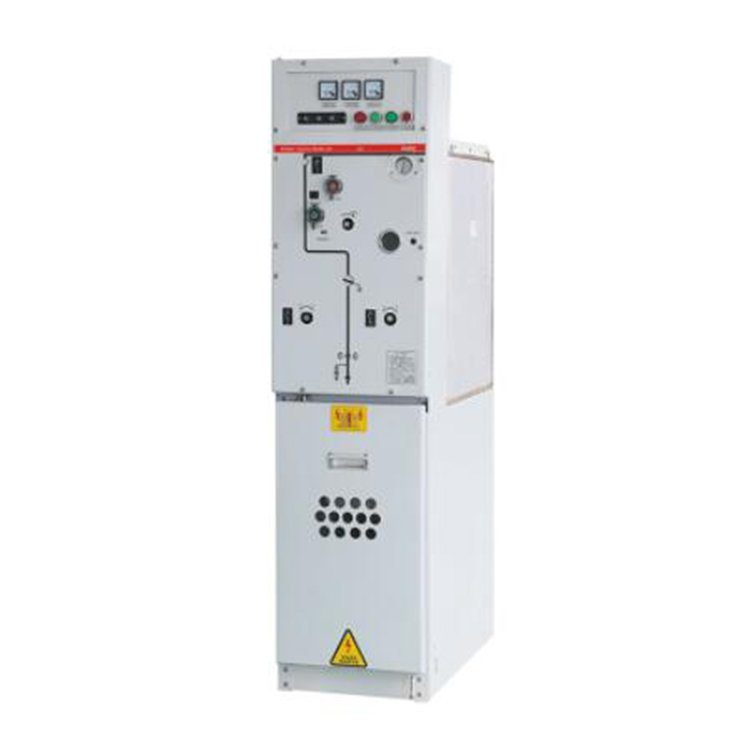
A dry-air insulated RMU: vacuum interruption, no fluorinated greenhouse gas in the insulating medium, and therefore no Article 13(9) commissioning issue in the EU.
Delivery, Service, And Documentation
In 2026 a quotation is judged on three things that are not the price. The first is what the lead time is measured from. “Twelve weeks” can mean twelve weeks from order acknowledgement, from approved drawings, or from receipt of the down payment, and those three starting points can differ by six weeks on the same order. Ask which one applies, and ask for the production slot to be reserved rather than the price to be held.
The second is service scope, which is usually underspecified on both sides. Clarify who commissions, whether a factory engineer attends first energisation, how many days of on-site support are included, and what the response commitment is for a warranty claim. For SF6 equipment, ask who holds the gas handling certification and whether the manufacturer will take the unit back at end of life. Under the EU rules that last question is now part of compliance rather than good manners.
The third is documentation, which is the cheapest risk control in the whole order and the most commonly deferred. A complete package contains type test certificates from an accredited laboratory, routine test reports for the actual serial numbers shipped, the as-built single line diagram, the wiring diagram, nameplate data, the O&M manual and, for digital units, the configuration file for the protocol you specified. Missing type test reports surface during utility approval, which is typically after the equipment has already shipped. Our guide to choosing a cost-effective switchgear supplier covers the commercial side of the same question.
Ring Main Unit Manufacturer Evaluation
Once the market view is settled, the question becomes which Ring Main Unit manufacturer to shortlist. In this category the answer is rarely “the largest”. It is the one whose standard configuration matches your project with the fewest modifications, because every modification adds a drawing cycle, a testing step and a week.
Product Options And Project Fit
A Ring Main Unit is not a single product. It is a busbar with functional units bolted to it, and the unit mix is what you are actually buying. The conventional notation is V for a vacuum circuit breaker unit, C for a load-break switch unit, and F for a load switch with fuse. A typical three-unit arrangement is C–C–V: two cable ways to close the ring and one breaker feeding the transformer. A four-unit adds a second C for an extra cable way or an F where a fused transformer protection is acceptable.
The configuration decision comes down to four questions: how many cable ways you need to close the ring, whether the transformer is protected by a breaker or a fuse, whether you need metering on the unit, and whether it must be extensible later. Answer those before you ask for a price, because they change the frame, the busbar and the enclosure depth.
A worked example makes the interaction clear. Take a 24 kV urban distribution project inside the EU, commissioned in the second half of 2026. An SF6 unit cannot be energised without a derogation, so the choice narrows to dry air or solid. If the site is a basement room with tight access and no gas monitoring, solid insulation usually wins on volume and on the absence of any gas-handling obligation. Move the same project to a market without that constraint and an SF6 block is smaller, cheaper and has a longer installed base. Neither answer travels. Our comparison of RMU versus GIS compact switchgear covers the cases where the boundary blurs.
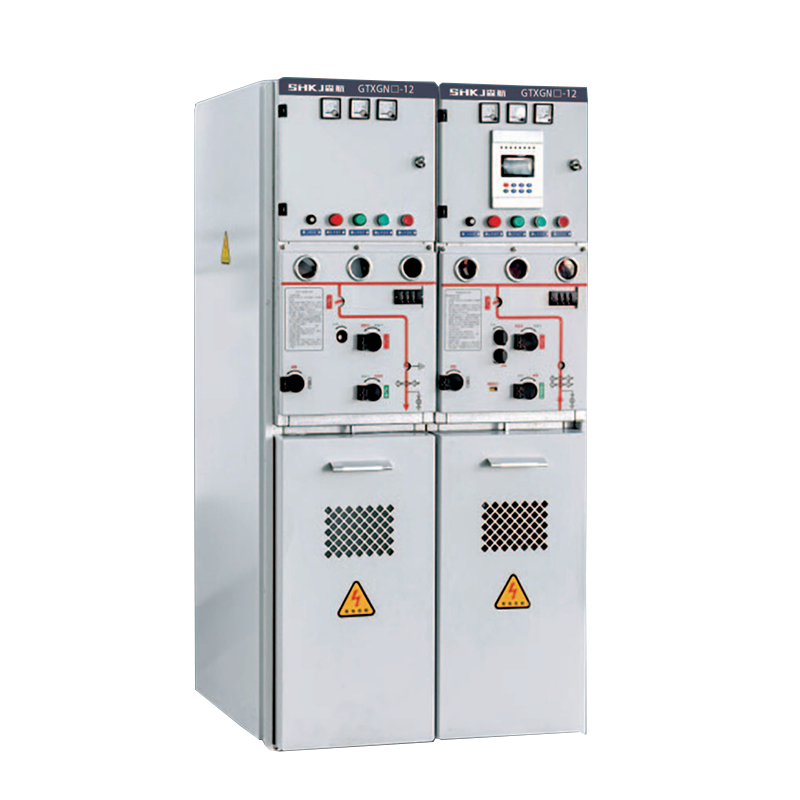
A solid-insulated RMU: busbars and interrupters sealed in epoxy, no gas to monitor, no gas to recover at end of life.
Electrical And Site Requirements
Most quotation delays are caused by missing site data, not by slow factories. The electrical parameters are the easy part: rated voltage, insulation level, rated normal current, rated short-circuit breaking current and its duration, peak withstand current, and the internal arc classification under IEC 62271-200. An engineer can write those in ten minutes from a single line diagram.
The site parameters are where enquiries go quiet. Altitude above 1,000 m derates insulation and must be declared. Ambient temperature range drives the enclosure rating and the cable termination design. Pollution level sets the creepage distance, and on coastal or heavy-industrial sites it decides whether a standard design is acceptable at all. Seismic zone affects the frame and the anchoring. Cable entry direction — bottom, rear or top — determines the trench and the pad. Weight matters for lifting and for the floor loading of a basement room. Our guide to selecting an RMU for industrial power systems works through the same checklist from the plant side.
Then the auxiliary scope: control supply voltage, battery or capacitor tripping, CT and PT ratios, protection functions, and the communication protocol. These are cheap to specify at enquiry stage and expensive to add after the drawings are approved, because they change the low-voltage compartment, the wiring schedule and the factory test routine.
Documents Before Quotation
A manufacturer can quote faster and more accurately from eight documents than from a paragraph of description. Send these and you will get a drawing and a comparable price back:
- Single line diagram showing unit configuration, ratings and cable ways
- Site conditions: altitude, ambient range, pollution level, seismic zone, indoor or outdoor
- Cable types, sizes and termination method
- Protection, metering and communication requirements, including protocol
- Applicable standards and any utility-specific clauses
- Required certification: type test reports, third-party witness, factory acceptance test attendance
- Delivery location, Incoterms and required date
- Quantity, phasing and any spares requirement
Without them you get a brochure and a spread of prices that cannot be compared, which is how a straightforward purchase turns into three rounds of clarification. The SH-SRM-12 gas insulated switchgear page shows the level of rating detail a manufacturer needs to quote against, which is a useful template for writing your own enquiry.
Send Us Your Single Line Diagram
BYYOU engineers review RMU enquiries against 12 kV and 24 kV solid, dry-air and SF6 platforms and return a marked-up drawing with the quotation. Send the SLD, the ratings and the site conditions — we will tell you which configuration fits and which one does not.
Common Errors When Using Market Reports
The same six mistakes show up in business cases and tender documents year after year. None of them is exotic, and all of them are expensive.
1. Reading a global CAGR as your growth rate. A 7.5% global figure averages a European replacement market growing slowly, an Asian new-build market growing quickly and an African infrastructure market growing from a very small base. Your addressable market is one of those, not the average.
2. Mixing product scopes. If the report counts RMUs only and your project also buys cable distribution cabinets and compact substations, the report says nothing about two thirds of your budget. Check the scope page before the numbers page.
3. Treating market value as a price index. Market value growth is not unit price inflation. In this category, prices for a given specification have generally fallen while total market value has risen, because more units are sold and each carries more electronics. Using the value CAGR as an escalation factor overstates your budget.
4. Ignoring the base year. A 2023 report with a 2030 forecast is a 2023 view of 2030. When a regulation changes in 2026, that view becomes wrong in precisely the segment you care about — the 24 kV segment that the EU rule just closed to new SF6 installations.
5. Assuming regulation is global. Article 13(9) of Regulation (EU) 2024/573 is an EU prohibition. Presenting it to a buyer in Southeast Asia as a market fact damages credibility with exactly the audience you are trying to reach. State the jurisdiction every time.
6. Citing a figure without provenance. If a market number goes into a business case, put the publisher, the report title and the year beside it. Numbers without provenance do not survive a review, and reviewers remember who supplied them. Our explainer on RMU definitions and working principles is written the same way — every technical claim traceable to a standard.
Frequently Asked Questions
Why Do RMU Market Reports Show Different Data?
Because they count different things. One report may total unit value, another installed cost, another smart units only, and base years differ. Use them for direction, not for budgeting.
What Specifications Should Buyers Provide When Requesting An RMU Quotation?
Send the single line diagram, rated voltage and short-circuit level, site altitude and ambient range, cable sizes, protection and protocol needs, applicable standards, quantity and delivery terms.
What Should Buyers Check Before Approving An RMU For A Power Distribution Project?
Check the type test certificates, the routine test report, the as-built single line and wiring diagrams, and that nameplate ratings match the order. Witness the factory test before shipment.
Conclusion
The Ring Main Unit market in 2026 is not short of demand; it is short of certainty. Published estimates disagree by about a fifth, the European rulebook changed on 1 January, and delivery slots on popular ratings are contested. None of that removes the decision — it only raises the cost of making it late. Buyers who do well here do three things: they budget from their own bill of materials, not a headline number, they choose an insulation technology against the regulation that will apply at commissioning, and they send a complete technical package. Everything after that is negotiation.
Specify An RMU That Still Complies At Commissioning
BYYOU manufactures 12–24 kV Ring Main Units in solid, dry-air and SF6 insulation, with integrated protection and IEC 61850-ready controllers, plus OEM and ODM support for utilities, EPCs and panel builders. Tell us the project location and the commissioning date — we will tell you which platform the rules allow.
Related Resources
- Power Smarter: The Key Benefits of an RMU in Modern Power Stations
- How Long Does High Voltage Switchgear Last? Lifecycle and Maintenance
- China Ring Main Unit vs European RMU: Key Differences
- How an RMU Reduces Installation Cost: A Manufacturer’s View
- Complete Guide to High Voltage Switchgear in 2026
- Top 10 High Voltage Switchgear Manufacturers in 2026


