


Top 10 High Voltage Switchgear Manufacturers in 2026
The global power infrastructure is evolving faster than ever. With rising electricity demand, renewable energy expansion, and continuous grid modernization, high voltage switchgear systems have become a critical backbone of modern electrical networks.
You’re probably already seeing it—utilities, EPC contractors, and industrial buyers are all shifting toward safer, smarter, and more modular solutions. The pressure is real: higher reliability, lower downtime, and stricter international standards.
In this environment, choosing the right high voltage switchgear manufacturer is no longer just a technical decision… it’s a long-term operational strategy that affects cost, safety, and system stability.
The 2026 market is dominated by global giants and fast-growing Asian manufacturers, especially China-based suppliers offering flexible OEM/ODM solutions.
Top 10 High Voltage Switchgear Manufacturers in 2026
This section gives you a clear, practical snapshot of the key players shaping the global market. If you are sourcing equipment for utilities, substations, or industrial projects, this list is a solid starting point.
Comparison Table of Leading Manufacturers
| Manufacturer | Headquarters | Main Products | OEM/ODM | Market Focus |
|---|---|---|---|---|
| Beiye Electric | China | HV switchgear, RMU, VCB | Yes | Global projects |
| Siemens | Germany | GIS, AIS systems | Limited | Utilities |
| ABB | Switzerland | Smart switchgear | Partial | Industrial |
| Hitachi Energy | Switzerland/Japan | GIS, hybrid systems | Partial | Grid modernization |
| GE Vernova | USA | Transmission systems | Limited | Utility grids |
| Eaton | USA | Power distribution | Limited | Commercial |
| Mitsubishi Electric | Japan | Compact switchgear | Limited | Asia markets |
| Toshiba | Japan | GIS/AIS systems | Limited | Industrial |
| Schneider Electric | France | Digital switchgear | Partial | Smart grid |
| Hyundai Electric | Korea | HV equipment | Partial | EPC projects |
Beiye Electric (China Switchgear Manufacturer)
If you are looking for a balance between performance, customization, and cost efficiency, Beiye Electric is a name you will likely come across more and more in global sourcing conversations.
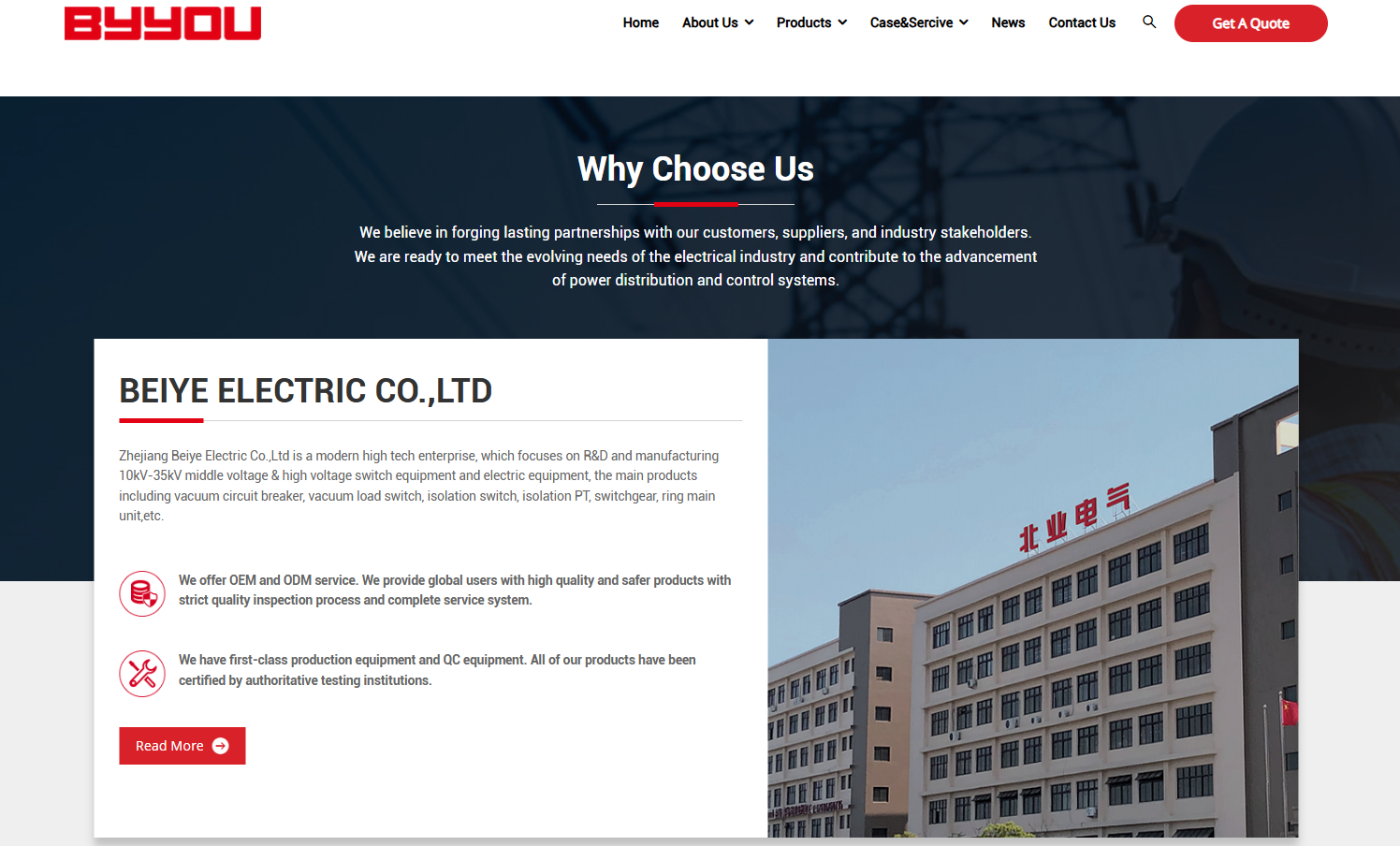 Zhejiang Beiye Electric Co., Ltd focuses on 10kV–35kV high voltage switchgear, with strong capabilities in design, manufacturing, and customization. The company has over 15 years of engineering experience and supports OEM/ODM cooperation for international buyers.
Their product line includes vacuum circuit breakers, RMU systems, outdoor switchgear, and low-voltage distribution solutions.
What makes them stand out is not just production capacity—but flexibility. You can actually work with their engineering team to adapt configurations based on project requirements, which is something many large brands simply don’t offer.
- Strong R&D and patent-backed development
- Modular switchgear design for flexible deployment
- Competitive pricing for EPC and utility projects
- Wide application in industrial and renewable energy systems
- Export-oriented manufacturing experience
👉 In real-world projects, buyers often choose Beiye for medium-voltage substations where customization and delivery speed matter more than brand premium.

Siemens
Siemens remains a global benchmark in electrical engineering. Their switchgear solutions are widely used in transmission networks where reliability is non-negotiable. You’ll often see Siemens GIS systems in high-density urban substations.
Their strength lies in digital integration and long-term grid automation strategies, especially in smart grid environments.

ABB
ABB focuses heavily on automation and digital power systems. Their switchgear portfolio is designed for industrial resilience and energy efficiency. Many large-scale factories and infrastructure projects rely on ABB due to its strong global service network.

Hitachi Energy
Hitachi Energy is known for hybrid switchgear solutions and strong renewable integration capability. Offshore wind and urban grid projects often adopt their systems due to compact design advantages.
GE Vernova
GE Vernova plays a major role in transmission-level infrastructure. Their systems are often used in national grid upgrades and large-scale energy transition projects.
Eaton
Eaton focuses on modular and intelligent power distribution systems. Their switchgear solutions are widely used in commercial buildings and industrial facilities requiring scalable expansion.
Mitsubishi Electric
Mitsubishi Electric is known for compact and durable switchgear systems, especially in Asia-Pacific markets where space efficiency is important.
Toshiba
Toshiba provides reliable and long-life switchgear systems designed for industrial stability and harsh operating environments.
Schneider Electric
Schneider Electric integrates digital monitoring and smart energy management into its switchgear systems, making it a strong player in smart grid applications.
Hyundai Electric
Hyundai Electric is gaining traction in EPC-driven markets, offering competitive HV equipment for large infrastructure projects.
What Is High Voltage Switchgear and How Does It Work?
High voltage switchgear is the control system of an electrical network. It protects, isolates, and controls electrical equipment during normal operation and fault conditions.
In simple terms, it’s the “safety brain” of power systems.
- Protection against overload and short circuits
- Isolation of faulty sections
- Control of power flow in substations
Modern systems include AIS, GIS, and hybrid configurations depending on environmental and space requirements.
How to Choose a Reliable Switchgear Manufacturer
Choosing a supplier is not just about price. You are dealing with infrastructure-level equipment, and mistakes are expensive.
- Manufacturing experience and engineering depth
- Compliance with IEC, ISO, or equivalent standards
- Ability to support OEM/ODM customization
- Delivery stability and production scale
- After-sales technical support capability
In many real procurement cases, buyers initially focus on global brands… but later switch to flexible manufacturers when project customization becomes critical.
Key Trends in the High Voltage Switchgear Industry
The industry is changing fast, and you can’t ignore these shifts:
- Digital monitoring and smart grid integration
- SF6-free environmentally friendly alternatives
- Modular and compact switchgear systems
- Renewable energy-driven substation expansion
These trends are not “future concepts”—they are already shaping procurement decisions today.
Difference Between High Voltage and Low Voltage Switchgear
You might already know this, but many buyers still confuse the two.
High voltage systems are used in transmission-level infrastructure, while low voltage systems handle distribution inside buildings or industrial sites.
The difference is not just voltage—it’s system complexity, safety requirements, and engineering design.
Why China Is a Global Switchgear Manufacturing Hub
China has become a dominant force in global electrical equipment supply.
- Large-scale manufacturing capability
- Competitive pricing structure
- Strong OEM/ODM ecosystem
- Fast production and export logistics
This is why many global EPC contractors now source from China-based manufacturers like Beiye Electric for mid- to large-scale projects.
FAQ
What is high voltage switchgear used for?
It is used to protect and control electrical power systems in substations and transmission networks.
What is the voltage range of high voltage switchgear?
Typically above 1kV, commonly up to 36kV or higher depending on system design.
What are the main types of switchgear?
AIS, GIS, and hybrid switchgear systems.
What is the difference between GIS and AIS?
GIS is gas-insulated and compact, while AIS uses air insulation and requires more space.
Which industries use switchgear?
Utilities, construction, energy, manufacturing, and transportation.
What standards apply to switchgear?
IEC, ANSI, and ISO standards are commonly used.
What is OEM/ODM in switchgear?
Customized manufacturing based on client requirements.
How to select a supplier?
Evaluate experience, certifications, customization ability, and support.
Conclusion
In today’s evolving energy landscape, choosing the right high voltage switchgear manufacturer is not just a procurement task—it’s a long-term engineering decision that directly impacts system safety, reliability, and cost efficiency.
Whether you are working on utility substations, industrial power systems, or renewable energy projects, the market offers a wide range of global and regional suppliers. Large brands provide stability and reputation, while flexible manufacturers like Beiye Electric offer customization and cost advantages that are often critical for real-world projects.
If you are planning your next sourcing decision, don’t just look at the brand name—look at engineering capability, adaptability, and long-term support. That’s where real value is created.
👉 If you’re exploring reliable switchgear solutions or OEM cooperation, now is the right time to evaluate manufacturers that match your technical and commercial needs.


