


Auto Recloser vs Sectionalizer: 5 Differences And How To Choose For Distribution Systems
Specifying protection for a medium-voltage feeder comes down to one question: does this device need to interrupt fault current, or only isolate a section after someone else has already done so? That is the whole Auto Recloser vs Sectionalizer decision. Get it right and a fault on one lateral costs a few hundred customers a few seconds. Get it wrong and a single fault drops the entire feeder — or you pay for fault-interrupting capacity that never gets used. This guide covers the five differences that actually matter and how to specify each device.
Auto Recloser VS Sectionalizer: 5 Differences
Both devices are automatic, both are pole- or pad-mounted, and both are sold under the distribution automation banner. That is where the similarity ends. They sit at different points in the protection chain, and they fail in completely different ways. The table below is the short version; each difference is explained in the sections that follow.
| Criterion | Auto Recloser | Sectionalizer |
|---|---|---|
| Fault interruption | Yes — rated symmetrical interrupting current, typically 12.5–25kA | No — load-break and making duty only |
| Working principle | Vacuum interrupter driven by a protection relay and controller | Current-pulse counter that opens in the upstream dead time |
| Reclosing | Programmable sequences, usually one to three shots | None — entirely dependent on the upstream device |
| Settings | Overcurrent curves, earth fault, dead time, reset time, cold load pickup | Count, reset time, minimum actuating current |
| Standalone use | Yes | No — requires a reclosing device upstream |
| Typical location | Feeder head, tie point, long rural lateral | Mid-feeder, downstream of a recloser |
| Relative capital cost | Higher | Lower |
1. Automatic Circuit Recloser Functions
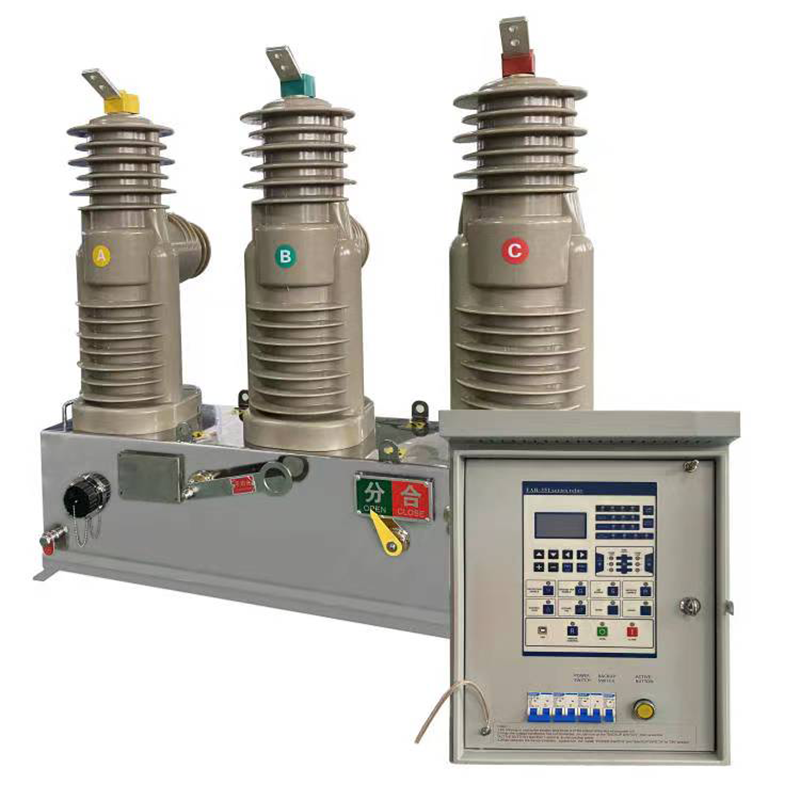
An automatic circuit recloser is a self-contained protective device for overhead and pad-mounted distribution systems, standardized under IEEE C37.60 and IEC 62271-111 for voltages up to 38kV. Physically it is a vacuum interrupter inside a sealed pole or tank, current transformers for measurement, a magnetic or spring actuator, and a controller that holds the protection logic. The vacuum bottle does the switching; the controller does the thinking.
Its job list is longer than most buyers assume. A modern distribution recloser performs phase and earth overcurrent protection, timed and instantaneous tripping, automatic reclosing with adjustable dead times, lockout after a preset number of shots, sequence coordination with downstream devices, inrush restraint, cold load pickup, fault current measurement, event recording, and remote control over SCADA. Because it carries a genuine fault-interrupting rating, it is the only one of the two devices that can clear a fault without help.
Take a pole-mounted 24kV unit with a permanent-magnet actuator and a solid-sealed pole that integrates the current sensor, voltage sensor and vacuum interrupter into one epoxy casting. The controller adds three-stage overcurrent protection, zero-sequence protection, reclosing and quick-break, with a capacitor energy store plus battery backup sized for roughly 48 hours of operation after loss of auxiliary supply. Communication runs over GPRS, fibre, Ethernet or RS-485 into an FTU. That is what a feeder-head device looks like in practice — the BZX32-24/630-25 vacuum Auto Recloser is a working reference point for this architecture.
2. Sectionalizer Functions
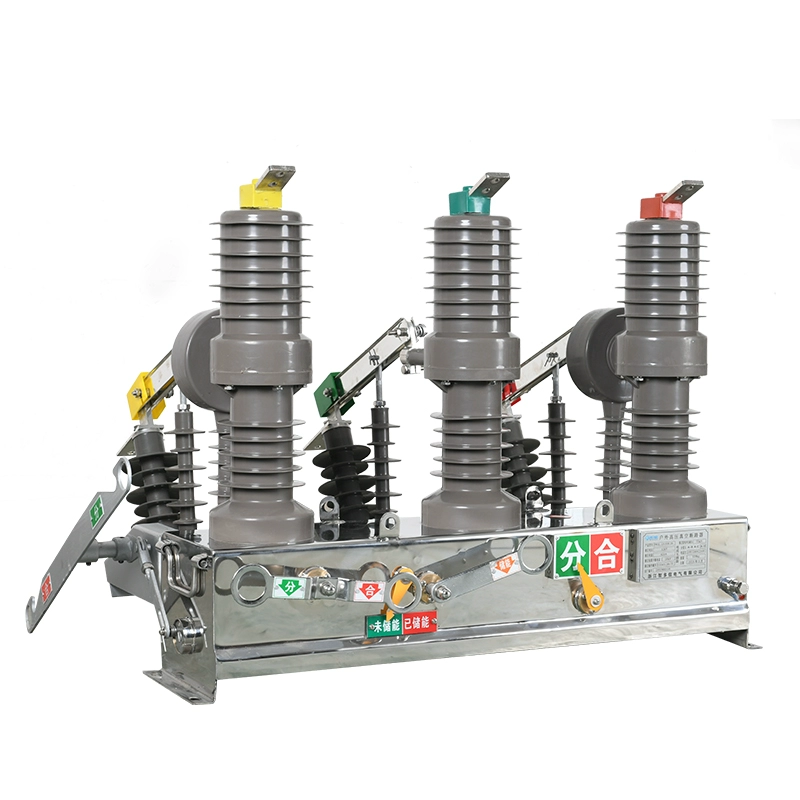
A Sectionalizer is deliberately simpler, and that simplicity is the entire point. Standardized under IEEE C37.63, it has no fault-interrupting rating at all. What it has is a counter. When fault current above its minimum actuating threshold passes through, the Sectionalizer registers a pulse. It keeps counting across the reclosing cycle of the upstream device. Then, during a dead time — when the line is already de-energized and current has fallen to zero — it opens.
This is why a Sectionalizer can use a comparatively light actuator. It never has to extinguish an arc carrying 12kA. It only has to open a circuit that is already dead, then hold isolation. Older units were hydraulic and counted with a solenoid and an oil dashpot; modern electronic Sectionalizers add inrush restraint, independent reset times and optional voltage-based logic, but the operating principle has not changed in fifty years.
The constraint that follows is absolute: a Sectionalizer cannot clear a fault on its own. If the upstream recloser fails to operate, or is set to a single shot, the Sectionalizer will count and wait and never act. It is a subordinate device, and any specification that treats it as standalone protection is a specification error.
3. Fault Interruption And Isolation
This is the difference that governs everything else. The recloser interrupts; the Sectionalizer isolates. Those are two different physical duties with two different ratings, and confusing them is how feeders end up mis-protected.
Fault interruption means extinguishing a vacuum arc while several thousand amperes are still flowing, within a few cycles, and recovering dielectric strength fast enough that the transient recovery voltage does not restrike. That demands a rated short-circuit breaking current, a rated short-time withstand current, and a tested operating sequence. Isolation means opening in a zero-current window and then holding against system voltage — a load-break duty, an order of magnitude easier.
The elegant part is that the two duties interlock. The recloser creates the window by tripping and holding off for its dead time; the Sectionalizer uses that window to open. Neither device can do the other’s job, and the sequence only works when the dead time is long enough for the Sectionalizer actuator to complete its stroke — in practice standard dead times of 0.3–2s are ample.
Why this matters for safety: a Sectionalizer that opens out of sequence, while current is still flowing, is being asked to interrupt a fault it was never tested to break. That is an arc-flash event, not a switching operation. Correct count and reset settings are therefore not tuning preferences; they are the integrity of the protection scheme.
4. Control, Reclosing, And Reset Logic
Open a recloser controller and you find a small protection relay: time-current curves selectable between ANSI U1–U4 and IEC inverse, very inverse and extremely inverse shapes, definite-time elements, earth-fault and sensitive earth-fault thresholds, reclose dead times per shot, a reset time after which the shot counter returns to zero, and a lockout state that requires manual intervention. Add event logs with fault current magnitude and timestamp, and you have the data that makes post-fault analysis possible at all.
A Sectionalizer’s setting list is three lines long: how many counts before it opens, how long it waits before resetting the count, and what minimum current counts as a fault. That last one is the subtle setting. Too low and motor starting or transformer inrush will increment the counter; too high and a remote fault at the end of a long lateral never registers.
Here is the sequence in numbers. A 24kV rural feeder has a recloser at the head set for two fast and two delayed trips, and a Sectionalizer 8km downstream. A fault beyond the Sectionalizer trips the recloser; the Sectionalizer counts one. The recloser recloses after 0.5s, the fault persists, the recloser trips again, and the Sectionalizer counts two. On the next dead time the Sectionalizer opens. When the recloser recloses, it holds — and only the section beyond the Sectionalizer stays dark. Now set that Sectionalizer to count three instead, and it never opens before the recloser locks out: a fault on one lateral takes the whole feeder down. The count is the scheme.
One practical note for buyers: many modern recloser controllers include a Sectionalizer mode, so a single hardware platform can be configured either way. That flexibility helps in retrofit work, but it does not make the two devices interchangeable on price — you are still paying for an interrupter you may not need. If you are still weighing whether you need reclosing at all, our explainer on what an electrical recloser does in modern power distribution covers the fundamentals.
5. Coordination And Cost
On capital cost alone, the Sectionalizer usually wins. In most tenders a three-phase electronic Sectionalizer lands at roughly 40–60% of the price of a comparable recloser, and the gap widens once you add the controller, current transformers, voltage source, battery and communications a recloser needs. A Sectionalizer also has almost no auxiliary system to maintain, which is why utilities deploy them in numbers on long rural laterals where a recloser per branch would be uneconomic.
But the comparison is not device against device; it is scheme against scheme. A Sectionalizer only delivers value when there is a reclosing device upstream to create the dead time. If the feeder head has no recloser, the Sectionalizer is decoration. The honest cost comparison is therefore one recloser plus n Sectionalizers, versus n reclosers. For a feeder with four laterals, the first option is usually 30–50% cheaper and delivers most of the reliability benefit.
Lifecycle cost tilts the same way for a different reason. Reclosers carry batteries that age, controllers that need firmware attention, and mechanisms that should be exercised on a schedule. Sectionalizers mostly just sit there, which is exactly what you want from a device installed at the top of a pole in a rice paddy.
Auto Recloser And Sectionalizer Applications
The division of labour becomes obvious once you look at where each device earns its place on a real feeder.
- Reclosers go at the feeder head. The substation feeder breaker position or the first pole out of the substation, because that is where fault current is highest and where reclosing returns the most reliability per dollar.
- Reclosers go at tie points. In loop and ring schemes the tie device must be able to close into a live fault and trip if the alternate source is faulted. A Sectionalizer cannot do this.
- Reclosers go on long rural laterals. High lightning exposure means temporary faults dominate, and one successful reclose avoids a truck roll entirely.
- Reclosers go at DG interconnections. Distributed generation needs directional elements and reclose blocking, which only a controller-based device provides.
- Sectionalizers go mid-feeder. Downstream of an existing recloser, where the goal is to stop a branch fault from taking out the main line.
- Sectionalizers go in URD and pad-mounted loops. Where a Ring Main Unit cabinet is available but a full recloser with controller and battery is impractical.
- Sectionalizers go on spur lines. Small customer clusters where the economics of a recloser per spur never close, and where pole space or foundation strength rules out a heavier device.
A worked layout: a 24kV feeder, 30km long, three laterals at 8, 17 and 24km, rural, lightning-prone, 1,800 customers. One recloser at the feeder head with two fast and two delayed trips. A Sectionalizer at each lateral take-off, counting two. A fault on lateral two now costs that lateral an outage and nothing else; the main line recloses and holds. Add a second recloser at the 24km point and you improve restoration for the last third of the feeder, but the marginal reliability gain per dollar drops sharply. That trade-off, not the device datasheet, is the design decision.
Get A Recloser And Sectionalizer Scheme That Actually Coordinates
Send us your single-line diagram, feeder length and fault current study. Our engineering team returns a device recommendation, coordination settings and a project-ready quotation — including the positions where a Sectionalizer is the smarter, cheaper buy.
How To Choose For Distribution Systems
Selection comes down to two questions: what does the feeder look like electrically, and what does the utility intend to do with it operationally. Everything else is detail.
Feeder Layout And Fault Current
Start with topology. A short radial feeder in a dense urban area with a single load centre rarely justifies sectionalizing at all — the customers downstream are the whole feeder, so isolating a section isolates everyone. A 30km rural feeder with four laterals is the opposite case: sectionalizing is where nearly all the reliability gain lives, and the question becomes how many devices the budget allows.
Then check fault current at every proposed device location, not just at the substation. A Sectionalizer needs the minimum fault current at its own position to exceed its actuating threshold with margin — a factor of two is a common working rule. On a long lateral with small conductor, end-of-line fault current can fall below 400A, and a Sectionalizer set for 500A will simply never count. In that case the answer is a recloser, a faulted circuit indicator with communications, or acceptance that the section stays unprotected.
Also check the fault current ceiling. If the recloser’s interrupting rating is 20kA and the bus fault level is 21kA, you have a problem no setting can fix. And check the X/R ratio: highly inductive industrial feeders produce DC offset that stresses interrupting duty beyond the symmetrical rating, which is why the asymmetrical rating matters in those applications. Voltage class selection follows the same logic — our comparison of 11kV vs 33kV vs 40.5kV outdoor vacuum circuit breakers walks through the classes.
Finally, distributed generation changes both ends of the calculation. Inverter-based sources contribute little fault current but can cause sympathetic tripping and reverse power flow. They raise the minimum-fault-current problem for Sectionalizers while complicating reclosing, because you generally do not want to reclose into an islanded section. If DG penetration on the feeder exceeds roughly 15–20% of peak load, specify a recloser with directional elements and a controller that supports reclose blocking, not a Sectionalizer.
Automation And Retrofit Requirements
If the utility runs a distribution management system and expects FLISR, every device you add is a node that must report. That immediately favours reclosers with proper controllers and standard protocols — DNP3 over TCP/IP, IEC 60870-5-104, or IEC 61850 where the substation architecture calls for it. A basic Sectionalizer is a blind spot: it does the switching job correctly but tells nobody.
Retrofit constraints are usually physical. Available pole space, device weight, foundation strength, climbing clearance, and whether a voltage source or auxiliary supply can reach the location all narrow the field quickly. A recloser needs a control cabinet, a battery, and usually a PT or capacitive divider; a Sectionalizer needs almost nothing. In pad-mounted URD loops the practical answer is often a Sectionalizer in the existing cabinet plus a recloser at the loop tie.
Do not overlook the setting and commissioning workload. A recloser requires a protection study, curve coordination against upstream and downstream devices, and a commissioning test that includes a real trip-and-reclose sequence. A Sectionalizer requires a count and a reset time — but those two numbers must still be derived from the upstream recloser’s sequence, and they must be documented, because the next engineer will need them. For projects mixing switchgear types on the same network, see our guide on selecting high voltage switchgear for power grid projects.
Common Coordination Mistakes To Avoid
- Setting the Sectionalizer count too high. The device never opens before the recloser locks out, so a lateral fault drops the whole feeder. This is the single most common commissioning error.
- Setting the count too low. The Sectionalizer opens on a transient fault that would have cleared on reclose, and you lose the reliability benefit you paid for.
- Forgetting the reset time. If the reset interval is shorter than the recloser’s full sequence, the counter never accumulates and the Sectionalizer never operates.
- Ignoring minimum fault current at the far end. A Sectionalizer that cannot see the fault is a very expensive line switch.
- Assuming a Sectionalizer protects anything on its own. No upstream recloser means no dead time, which means no operation. Ever.
- Specifying ratings without the fault study. A 12kV unit with adequate voltage but inadequate breaking capacity still fails the first real fault.
Why Specify BYYOU Auto Reclosers
Zhejiang Beiye Electric Co., Ltd (BYYOU) designs and manufactures 10kV–35kV medium- and high-voltage switchgear, including vacuum circuit breakers, load break switches, Ring Main Units and Auto Reclosers. Our R&D, production and service team brings more than 15 years of experience in the MV/LV electrical industry, working under an ISO 9001 quality management system, with products type-tested by accredited laboratories. We offer OEM and ODM service for utilities, EPC contractors and panel builders.
For recloser applications, the BYYOU Auto Recloser range covers pole-mounted outdoor units at 12kV and 24kV with permanent-magnet or spring mechanisms, integrated CT/PT solid-sealed poles, manual emergency opening, and intelligent controllers supporting three-stage overcurrent protection, zero-sequence protection, reclosing and quick-break. Communication options include GPRS, fibre, Ethernet, RS-485 and RJ45 for connection to FTU, TTU and DTU equipment. Where the requirement is switching and isolation rather than fault interruption, the load break switch range covers the sectionalizing duty at lower cost.
Frequently Asked Questions
What Standards Apply To Auto Reclosers?
Auto Reclosers follow IEEE C37.60 and its IEC twin, 62271-111, for AC systems up to 38 kV. Sectionalizers use IEEE C37.63. SCADA protocols belong in the controller spec, not the switch standard.
How Often Should An Auto Recloser Be Maintained?
Plan an annual inspection and a full service every three to five years, but duty cycle overrides the calendar. Battery, controller firmware and post-fault interrupter checks set the schedule.
Can One Recloser Control Serve Several Sectionalizers?
Yes. Three or four in series downstream is common practice, each set to a different count so only the unit nearest the fault opens. Beyond about four levels, add a second recloser.
Conclusion
The Auto Recloser vs Sectionalizer decision is not a product comparison; it is a question of what each device may do. The recloser interrupts fault current, recloses on its own schedule and can protect a feeder unaided. The Sectionalizer counts, waits for a dead time created by someone else, and isolates. Pair them correctly — recloser at the head, Sectionalizers down the laterals — and you capture most of the reliability benefit for a fraction of the cost. Pair them carelessly and the scheme fails.
Ready To Specify Your Distribution Protection?
BYYOU manufactures 12–24kV pole-mounted vacuum reclosers with permanent-magnet mechanisms, integrated CT/PT solid-sealed poles and intelligent controllers, plus OEM and ODM support for utilities, EPCs and panel builders. Send your ratings and we will return a project-ready specification.
Related Resources
- Recloser vs Circuit Breaker: Which One Is Better for Your Business
- How to Choose the Right Recloser: 7 Key Factors You Must Consider
- What Is an Electrical Recloser in Modern Power Distribution
- What Is an Outdoor Vacuum Circuit Breaker (Outdoor VCB vs Indoor VCB)
- 11kV vs 33kV vs 40.5kV Outdoor Vacuum Circuit Breakers: Which One Is Best
- Choosing Between Pole-Mounted and Ground-Mounted Outdoor Vacuum Circuit Breakers
- A Complete Guide to Vacuum Circuit Breaker (VCB)
- How to Select High Voltage Switchgear for Power Grid Projects
Further reading: Recloser and vacuum interrupter — background references.


