


High Voltage Ring Main Unit vs GIS: Compact Switchgear for Your Substation
What Is a High Voltage Ring Main Unit?
A High Voltage Ring Main Unit (RMU) is a compact, metal-enclosed switchboard built for ring-network distribution. In a ring topology each load point can receive power from two directions, so a fault on one feeder is isolated while the loop keeps supplying from the other side — delivering near dual-feed reliability from a single source. A typical RMU combines incoming/outgoing load break switches with a load switch–fuse combination for transformer protection, and is standardized for easy assembly and low lifecycle cost.
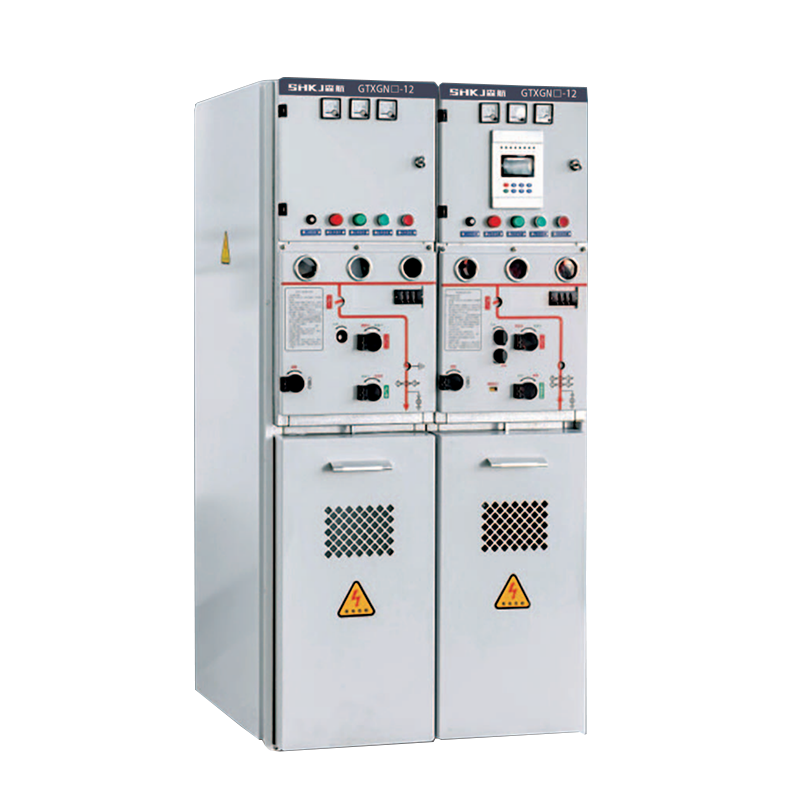
Most RMUs are rated for secondary distribution: rated current is generally capped at 630A with a short-circuit breaking capacity around 20kA, covering the vast majority of urban and light-industrial loads. Beiye Electric builds RMUs across the 10–35kV range, including the GTXGH Series solid-insulated ring main unit for SF6-free installations.
What Is GIS (Gas-Insulated Switchgear)?
GIS (Gas-Insulated Switchgear) is classified by its insulation technology rather than its application. The primary circuit — switch, vacuum interrupter, and connections — sits inside a sealed tank filled with insulating gas (commonly SF6, or eco-friendly alternatives). Because the live parts are fully sealed, GIS is immune to humidity, pollution, and salt fog, which is why it is the default choice for dense urban substations and heavy industry.
GIS scales from secondary to primary distribution: rated current typically runs 630–4000A with a short-time withstand of 25–50kA. It also supports circuit-breaker protection with relay tripping and integrated remote monitoring — a prerequisite for smart-grid and automation-ready substations. Beiye Electric’s SH-SRM-12 Series SF6 gas-insulated switchgear is engineered for exactly these high-demand networks.
High Voltage Ring Main Unit vs GIS: Key Differences
The fastest way to separate the two is side by side. The table below contrasts RMU and GIS across the factors B-end buyers actually weigh.
| Factor | High Voltage Ring Main Unit (RMU) | GIS (Gas-Insulated Switchgear) |
|---|---|---|
| Classification | Defined by ring-network application (secondary distribution) | Defined by gas-insulation technology (primary & secondary) |
| Rated current | Typically up to 630A | Typically 630–4000A |
| Short-circuit withstand | Around 20kA (fuse-assisted) | 25–50kA (breaker + relay) |
| Protection | Load switch–fuse combination | Breaker with relay protection & automation |
| Footprint | Very compact, modular | Compact, smallest per rated amp |
| Best for | Urban rings, buildings, light industry | Primaries, traction, smart-grid, harsh sites |
| Initial cost | Lower | Higher, offset by lower maintenance |
Can an RMU Use GIS Technology? (The Hybrid Trend)
Yes — and this is where the old RMU-vs-GIS divide blurs. Many modern RMUs seal their switching compartments with insulating gas or solid epoxy, borrowing GIS’s compactness and environmental immunity while keeping the ring-network topology and cost profile of an RMU. The result is a hybrid unit: ring-main flexibility with gas-insulated reliability. Beiye Electric’s SHAir-12 dry-air fully insulated ring main unit takes this further by removing SF6 entirely.
Which Compact Switchgear Should You Choose for Your Substation?
Use this decision logic when specifying:
● Load ≤ 630A, ring topology, budget-sensitive — choose an RMU. It delivers the reliability urban distribution needs at the lowest installed cost.
● Primary distribution, high fault level, or automation required — choose GIS with breaker + relay protection and remote monitoring.
● Space-critical but cost-conscious — a gas- or solid-insulated RMU (hybrid) is often the sweet spot.
● Environmental mandates (SF6 restrictions) — specify a dry-air or solid-insulated RMU.
● Full substation in one footprint — pair either technology with a compact substation package.
Need a compact switchgear quote for your substation?
Beiye Electric’s engineers help you size a High Voltage Ring Main Unit vs GIS for 10–35kV projects — with single-line diagrams, protection schemes, and lead time.
SF6-Free and Eco-Friendly Options
SF6 is an exceptionally potent greenhouse gas, so utilities and EPCs increasingly specify SF6-free switchgear. Two mature paths lead the shift: dry-air insulation (e.g., SHAir-12) and solid insulation (e.g., GTXGH). Both deliver the compactness and sealing of gas technology without the environmental liability — and they future-proof your substation against tightening SF6 regulations.
Why Source From Beiye Electric
Beiye Electric (Zhejiang Beiye Electric Co., Ltd) is a high-tech manufacturer focused on 10–35kV medium- and high-voltage switchgear. For B-end buyers, that specialization translates into tangible advantages:
● OEM & ODM service — configurations matched to your single-line diagram and branding.
● Proven project record — supply experience with major grid operators such as CSG and SGCC.
● Certified quality — products are certified by authoritative testing institutions, with QC from raw material to final delivery.
● Experienced engineering team — technicians with 15+ years in MV/HV switchgear.
● Full compact-switchgear range — from RMU and GIS to metal-enclosed switchgear and compact substations.
Frequently Asked Questions
Q: What is the difference between a High Voltage Ring Main Unit and GIS?
A: An RMU is defined by its application — ring-network secondary distribution with load switch–fuse protection, typically up to 630A. GIS is defined by its insulation — gas-sealed primary/secondary switchgear with breaker protection, higher ratings, and automation. Many modern RMUs adopt GIS insulation internally.
Q: Which is better for a compact substation: RMU or GIS?
A: For most 10–35kV compact substations serving buildings, campuses, and light industry, an RMU is the cost-effective default. Choose GIS when the load, fault level, or automation requirement exceeds what an RMU can deliver.
Q: Can a Ring Main Unit use GIS technology internally?
A: Yes. Gas-insulated and solid-insulated RMUs use sealed compartments that borrow GIS compactness and environmental immunity while keeping the ring topology and lower cost of an RMU — a true hybrid solution.
Q: What are the typical ratings of a ring main unit?
A: RMUs are generally rated up to 630A with a short-circuit breaking capacity around 20kA, covering 10–40.5kV secondary distribution. Exact values vary by model — confirm against the specific product datasheet.
Q: Is SF6 being replaced by SF6-free alternatives in RMU and GIS?
A: Increasingly yes. Dry-air and solid-insulated designs eliminate SF6’s greenhouse impact while keeping the compactness of gas technology, and they help future-proof assets against tightening SF6 regulations.
Q: How do I choose between RMU and GIS for my substation project?
A: Start from load current, fault level, space, automation needs, and environmental rules. ≤630A ring networks on a budget → RMU; primary/high-fault/automated → GIS; space-critical but cost-conscious → insulated RMU hybrid.
Q: What does a ring main unit cost compared with GIS?
A: RMUs have a lower initial cost thanks to standardized parts and load switch–fuse protection. GIS costs more up front but offsets it with lower maintenance and longer service life in demanding networks.
Specifying RMU or GIS for your next substation?
Send us your single-line diagram and requirements. Our team returns a matched, certified compact switchgear proposal with competitive lead times.
Related Resources
● HV Switchgear & RMU product category — full RMU and switchgear lineup.
● Compact Substation category — integrated substation packages.
● GTXGH Series Solid-Insulated Ring Main Unit — SF6-free RMU details.
● SH-SRM-12 Series SF6 Gas-Insulated Switchgear — GIS specifications.
● HXGN Series AC Metal-Enclosed Switchgear — air/gas metal-enclosed options.


