


Ring Main Unit (RMU) Definition, Advantages, Working Principle And Application
Ring Main Units (RMU), as compact and reliable switching devices, have become indispensable key components in urban power distribution networks, industrial parks, and various infrastructures. This article will comprehensively analyze the definition, function, working principle, and application scenarios of RMUs, and clarify their differences from related equipment.
What Is Ring Main Unit (RMU)?
Ring main unit (RMU) is a combination of high-voltage switchgear installed in a metal or insulated enclosure, typically used in medium-voltage distribution networks from 10kV to 35kV. Its core design revolves around the “ring network” concept, where two independent power supply lines form a ring-shaped power supply network. A standard RMU cabinet typically integrates load switches, disconnect switches, circuit breakers (optional), fuses, and grounding switches, and may be equipped with transformers, cable terminals, and other modules. Its key features are compact structure, full or semi-insulated design, low maintenance, and flexible power supply connection and isolation.
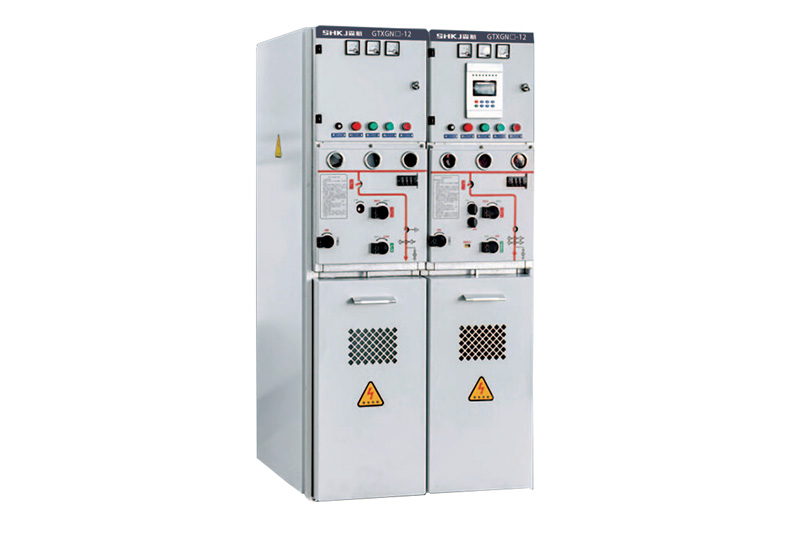
Key advantages include:
High reliability: Dual-power ring network design; a fault in one line can be quickly switched to the other.
Small footprint: Utilizes SF6 gas insulation or solid insulation, compact structure, suitable for space-constrained locations.
High safety: Fully enclosed design, high protection level, safe operation.
Flexible expansion: Modular design, easy to add or adjust functional modules.
Easy maintenance: Maintenance-free or low-maintenance design, low life-cycle cost.
What Is The Purpose Of A Ring Main Unit?
The core purpose of a ring main unit (RMU) is to construct a flexible, reliable, and economical power supply ring network in a medium-voltage distribution network. Specifically:
Ring Network Power Supply: Connects two or more power sources to form a closed-loop network. When the main power supply line fails, the load can be quickly switched to a backup line by operating the switches within the RMU, greatly shortening power outage time and improving power supply continuity.
Power Distribution and Control: Serves as a branch or terminal point of the line, distributing, connecting, and disconnecting outgoing lines, and providing protection and control for distribution transformers.
Providing Protection: Provides overload and short-circuit protection for downstream equipment such as transformers and cables through its internal fuse combination appliances or circuit breakers.
Isolation and Grounding: Provides clear circuit isolation points and is equipped with grounding switches to ensure personnel safety during line maintenance.
How Does A Ring Main Unit Work?
The operating principle of the RMU revolves around its standard functional units. Taking a typical SF6 gas-insulated RMU with two incoming lines and a substation unit as an example:
Normal Power Supply: Two incoming lines (e.g., L1 and L2) are connected via the RMU’s incoming load switches. Typically, one line (e.g., L1) serves as the main power supply, its switch closed, supplying power to the connected distribution transformer; the other line (L2) serves as hot standby, its switch open but in hot standby mode. The transformer circuit is usually protected by a “load switch-fuse combination”.
Fault Switching Operation (taking a fault in the main incoming line L1 as an example):
Fault Detection: The upstream protection device detects a fault in line L1 and trips.
Fault Isolation: On the RMU, the operator or automation system disconnects the L1 incoming line load switch and closes its grounding switch (ensuring safety), isolating the faulty line from the ring network.
Power Restoration: The load switch for the standby incoming line L2 is closed. At this time, power continues to supply power to the transformer via the L2 incoming line, through the internal busbars of the RMU. The entire process can be completed within minutes, enabling rapid restoration of non-faulty sections.
Local Protection: When an internal fault occurs in the transformer, the high-voltage fuse on its high-voltage side will quickly blow, cutting off the fault current. The associated striker will trigger the load switch to trip, achieving three-phase linkage isolation and preventing single-phase operation.
Where Are Rmus Commonly Used?
Thanks to its high reliability and compact design, RMUs are widely used in locations requiring uninterrupted or high-quality power supply:
Urban power distribution networks: Cable ring network nodes in streets, residential areas, and commercial centers are the most typical application scenarios for RMUs.
Industrial parks and factories: Providing reliable power distribution to workshops and production lines.
Infrastructure:
Airports, train stations, and subways: Ensuring power supply to critical transportation hubs.
Hospitals and data centers: Lifeline projects with extremely high requirements for power continuity.
Schools, large commercial complexes, and sports stadiums.
Renewable energy sector: Power collection and distribution systems for photovoltaic power plants and wind farm step-up substations.
Mines and oil fields: Industrial sites with harsh environments but requiring reliable power supply.
As the high-voltage section of prefabricated substations (panel transformers).
FAQ
Which Is Better, RMU Or VCB?
This is a common misconception. A vacuum circuit breaker (VCB) is a breaking element, while an RMU is a complete set of equipment. An RMU can internally use a load switch, a load switch-fuse combination, or a VCB as its functional unit.
RMU using VCB: Strong breaking capacity (can interrupt short-circuit current), more comprehensive protection performance, suitable for important outgoing lines or as the first-end protection of ring network branches, but more expensive.
RMU using load switch-fuse combination: More economical, relies on fuses for transformer protection, and relies on fuses to interrupt short-circuit current, suitable for terminal distribution (such as transformer protection).
Conclusion: There is no absolutely “better” option; the key is the application requirements. For applications such as transformer protection, the load switch-fuse combination is more cost-effective; for applications requiring frequent operation or line protection, the VCB unit is more suitable.
What Is The Difference Between Rmu And Ht Panel?
Ring Main Unit (RMU): Specifically refers to a complete set of medium-voltage switchgear with a particular type and function used to construct a ring network power supply. Its core is the ring network function (dual or multiple incoming lines).
High Voltage (HT) Panel/Switchgear: This is a broader term referring to all combinations of switchgear used in medium-voltage (e.g., 11kV) systems. It includes RMUs, as well as other types such as incoming line cabinets, metering cabinets, PT cabinets, outgoing line cabinets, busbar tie cabinets, etc.
Simple analogy: HT panels are like “office buildings,” while RMUs are like “apartment units” with a specific layout (ring network function). Not all HT panels are RMUs, but an RMU is a specific configuration of an HT panel.
What Is The Difference Between Substation And Rmu?
Substation: A complete power conversion and distribution station, typically including transformers (for changing voltage levels), high-voltage switchgear, medium-voltage switchgear, low-voltage switchgear, control systems, protection equipment, and auxiliary facilities. It can vary in size (e.g., 110kV/10kV substations, 10kV/0.4kV prefabricated substations).
Ring Main Unit (RMU): A component within a substation, usually belonging to the medium-voltage distribution network side of the switchgear. It typically does not include a transformer (unless it is an integrated type).
Relationship: On the 10kV outgoing side of a substation, multiple RMUs may be used to construct a distribution network loop or distribute power. RMUs can also serve as high-voltage receiving units in small prefabricated substations (panel substations).
Conclusion
Understanding the working principle of a ring main unit (RMU) and clarifying its differences from VCB, HT panels, and substations helps in selecting the most suitable solution for a specific power engineering project.
Immediately assess your power distribution needs and consult with professional engineers to inject “ring network” level reliability and flexibility into your power grid.
Tag:What Is Ring Main Unit,What Is A Ring Main Unit


